
ELRE
Natural swimming pool for a villa: an architect's guide to design, water and upkeep
Natural swimming pool: how it works, how much space it takes and what public research says about water quality and upkeep, explained by architects.
Natural swimming pool for a villa: how it is designed and what it really promises
A natural swimming pool is a bathing pool cleaned without chlorine, with plants and a soil filter in place of chemicals. The idea is appealing for a villa with a garden: the water joins the landscape instead of being a blue rectangle beside the house. But a natural swimming pool is a technical installation that behaves like a small ecosystem, and anyone who designs it as a pool without chlorine watches it turn green. That is why a natural swimming pool is drawn with the landscape, the hydraulics and the botany at the same table.
Most pages that Google shows for this search are guides by firms that build these pools, with costs and permits. We do something else: we explain, as architects, how a natural swimming pool works, what public sources tell us and where commercial promises should be read with care. We do not sell installations, we do not cite brands and we do not give current prices, because without a design they would be invented numbers.
Natural swimming pool at a glance
- Three areas: use area, treatment area and technical area work as one system.
- The treatment area is not a decorative extra: in the guidance for public sites it is at least as large as the swimming zone.
- Water quality depends on bathers, on the filling water and on the garden around.
- Maintenance is always there: algae, sludge, plants and checks.
- Permits depend on the municipality and the region: ask before the design.
The Villa Edit
Materials and systems of the villa
Infinity pool
The guide
Outdoor kitchen
The guide
Green roof
The guide
Solar and battery
The guide
Preliminary reading
Understand a villa before you buy it
Signature Architecture
Design or renovate a villa
Contact
Write to us
What a natural swimming pool is, and what it is not
In Germany, where these installations have a long history, the technical reference is a guideline by the research society FLL. The Umweltbundesamt, the federal environment agency cites it as the rule for open-air pools with biological water treatment (Schwimm- und Badeteiche), in the 2011 edition, and keeps them apart from pools with chemical treatment. In Italy the terms vary: the same idea is sold as biopiscina or biolago. What matters to the builder is the system, not the name.
A natural swimming pool, then, is not a conventional pool with fewer products: it is something else, with a different logic. The water is not disinfected, it is purified through plants, substrate and organisms. The result is softer and less predictable, and it asks for a more careful design and a different kind of maintenance.
The three areas of a natural swimming pool
The leaflet of the Bavarian State Institute for Viticulture and Horticulture, written for public installations, describes a natural swimming pool as an artificial ecosystem split into three areas. The same logic holds, on a smaller scale, for a private natural swimming pool. The table sums it up.
| Area | What it does | What to check in the design |
|---|---|---|
| Use area | Where you swim: depths, steps, edges | Safety, access, slopes, materials that do not release nutrients into the water |
| Treatment area | Plants, a planted soil filter or a regeneration pond clean the water | Surface relative to the swimming zone, substrate, water circulation |
| Technical area | Pumps, flow regulators, fine filters and settling tanks | Access for maintenance, noise, drainage, maintenance plan |
The leaflet states a point that quotes tend to hide: depending on the technique, the treatment area should be at least as large as the swimming area, and for public sites the orientation is 5 to 15 square metres of installation for every square metre of use area. These figures are meant for public sites, so they do not apply as they are to a villa, but they give the order of magnitude of the problem: a natural swimming pool takes far more garden than a conventional pool with the same swimming area.
Explore our projects
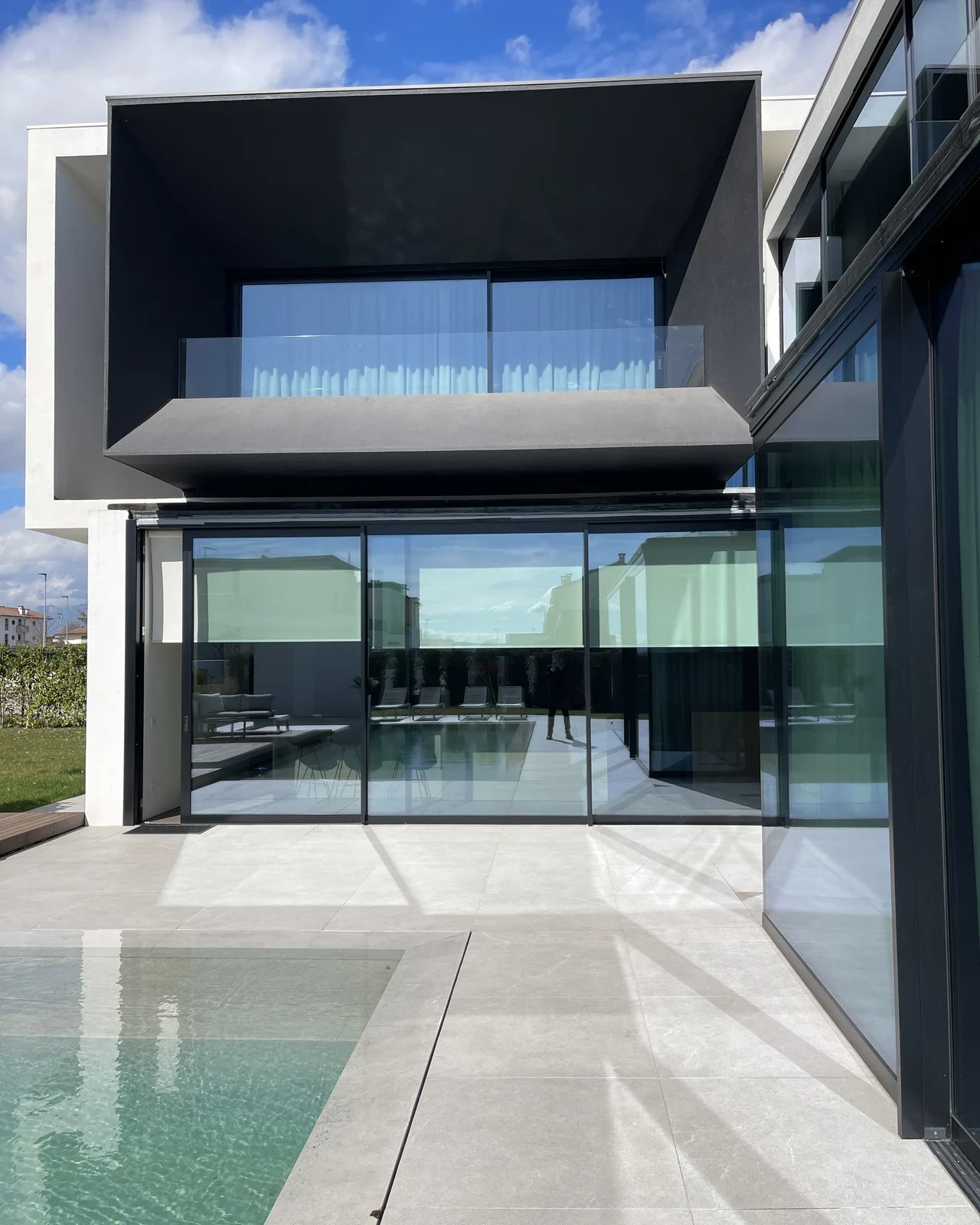
Metra glazing, Viabizzuno and OTY lighting, infinity pool: design and site direction by the studio.
Invest
Before buying a luxury villa in Italy, the Dominican Republic, Zanzibar or Dubai: send us the…
How the water of a natural swimming pool is cleaned
The Bavarian leaflet explains that the heart of the system is self-purification: the settling and mineralisation of organic matter, the binding of minerals in the mud at the bottom and the removal of germs by zooplankton. To support it, planted soil filters, regeneration ponds, fine filters and settling tanks are used. The planted soil filters are named as the key element: there the used water is cleaned in natural conditions, with little energy and a large buffering capacity.
The substrate of the filters is chosen among open-pored mineral mixtures and natural zeolites; the leaflet reports that even washed sand can compete with special substrates, but that none of those used in the Bavarian installations managed to remove large amounts of phosphate from the water. A practical consequence follows: even with the best system, a natural swimming pool requires constant attention to algae.
Phosphorus, algae and filling water
Phosphorus is the nutrient that makes algae grow, and a natural swimming pool receives it from many sides. The leaflet indicates that each bather brings about 0.1 grams of phosphorus a day, and that the phosphate of the filling water should be tested at the design stage, not only after the pool is running. Using phosphate-free water, together with efficient treatment, is given as the only way to tackle the main cause of algae growth.
Other sources of nutrients are run-off from surrounding ground, leaves and dust carried by wind, and animal droppings. Against these the leaflet suggests solutions that belong to the architect more than to the engineer: kerbs, capillary breaks, drains and buffer strips around the pool. The materials in contact with the water matter too, because they can change the pH or release salts: durable materials are used, which do not feed algae.
Explore our projects

Schüco glazing, Minimal Cucine and Modulnova kitchen, Poliform and Baxter furniture, Occhio lighting, MAFI wood.
Architecture
UHNW luxury villa architecture designed and supervised by Federico Cappellina’s studio since 2002…
Temperature, germs and season
A natural swimming pool is not disinfected, so hygiene depends on the balance of the system. The leaflet notes that with water temperatures above 23 degrees Pseudomonas aeruginosa appears more often, whatever the system, and tends to disappear as the water cools; Escherichia coli and enterococci are reported as rarely causing trouble. For a villa in northern Italy, where the water of a shallow basin easily crosses that threshold in summer, this is a point to settle in the design: shade, depth and water exchange all influence temperature.
The leaflet also reminds that after a restart in spring the full cleaning capacity is reached with a delay that can last three to four weeks, depending on size and weather. Whoever chooses a natural swimming pool must accept that the first part of the season is not perfect and that winter is not a pause: the installation is put to rest with a procedure.
Natural swimming pool and landscape: where to put it
A natural swimming pool works when it is part of the garden: soft edges, aquatic plants, a readable bathing zone and a regeneration zone that does not look like a service pond. The design starts from orientation and views: the water is placed where the light makes it live and where excess foliage will not dirty it. Large trees next to the pool are avoided, because of leaves, and so are areas where the ground drains towards the water.
The relationship with the house is drawn as for any pool: paths, seating, shade, view from the living rooms. For the shade you can think of a covered terrace at the side of the loungers, leaving the pool exposed; for the conventional alternative see our guide to the infinity pool, which explains what changes when the traditional solution is chosen. The outdoor living space around it can be completed with an outdoor kitchen.
Explore our projects
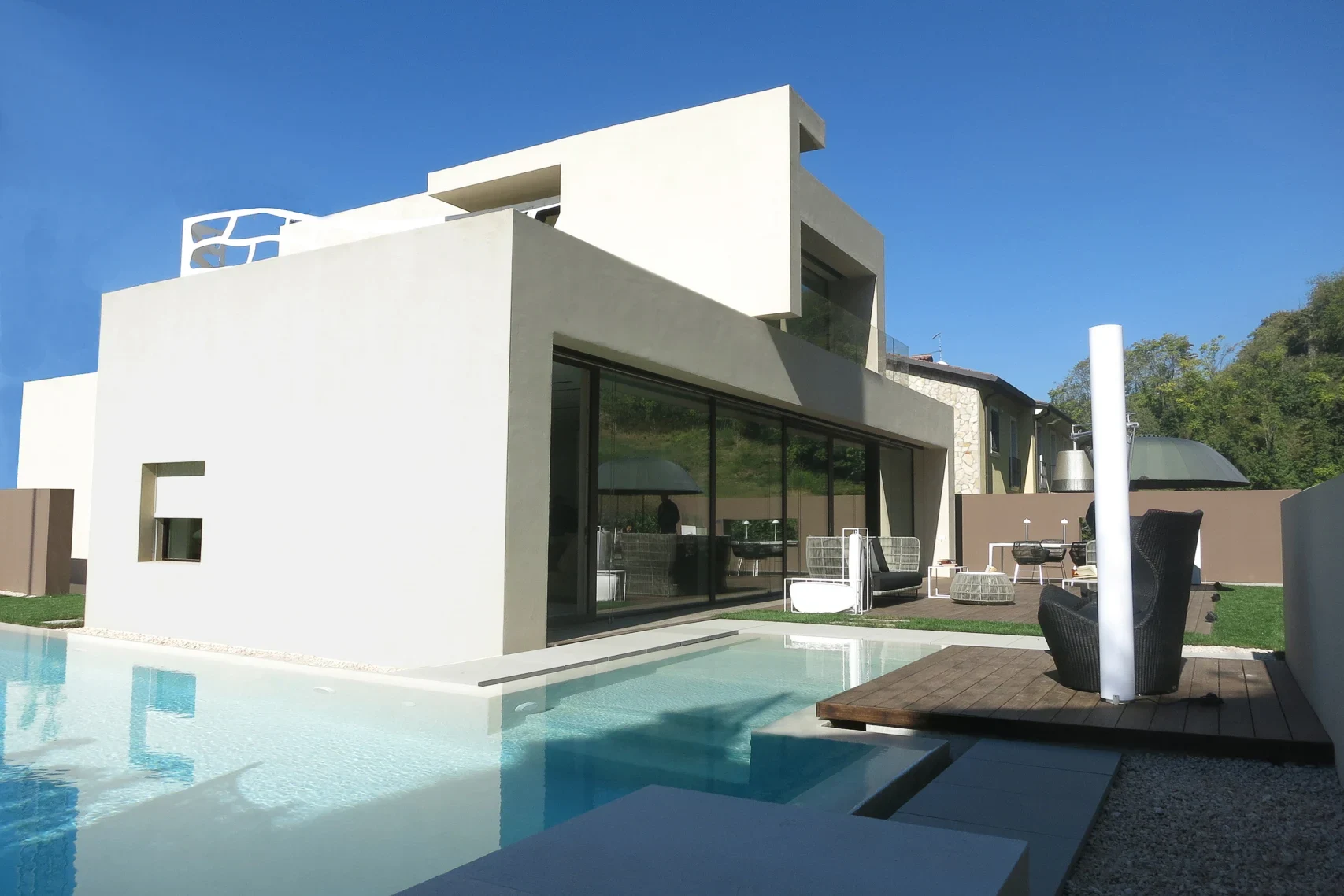
Edra sofas, Varenna kitchen, Noorth and Agape bathrooms: a studio project.
How much does a natural swimming pool cost
We do not give current prices, because they change with the ground, the treatment area, the shape and the lining, and pages with figures but no design are promises without proof.
To understand the relative order of magnitude, the Bavarian leaflet reports surveys from 2005 and 2006 on public German installations: for natural baths, average construction costs of around 495 euros per square metre of usable water surface (from 275 to 1,133) and average operating costs of about 18.50 euros (from 5.50 to 101), against 1,760 and 185 euros for conventional baths. These are old data, from another country and for public sites: they only say that the saving, if any, lies in running costs and not in construction.
The same leaflet warns that the construction costs of the two systems tend to converge, and that the savings of natural baths play out mostly in upkeep. For a villa the right question is not how much a natural swimming pool costs, but what the design, treatment area, excavation, waterproofing, plants, technical plant and years of maintenance cost together.
Invest
Outdoor kitchen design for a villa: layout, cover, masonry or stainless steel, worktops, services…

Permits and constraints
We have not verified the national or regional rules for natural pools on an official source, so we do not report them. What can be said is how to proceed: start from the municipal technical office to learn whether the natural swimming pool is treated as an ancillary pool or as another kind of work, check landscape protection, boundary distances, rules on discharges and water withdrawals, and whether the plot is in an agricultural or protected area. Anyone who arrives with a defined project, including sections of the treatment area, gets clearer answers.
Energy and plant: few, but to be thought through
A natural swimming pool uses less energy than a treated pool, but not none: the circulation pumps run all season. They can be powered by a solar and battery system, and if you want to heat the water you reason with the heat pump only after considering the effect on the biological system: the warmer the water, the more algae and germs are favoured. Pump schedules and water-quality alerts can be integrated into a home automation system.
Invest
Green roof for a villa in Italy, explained by architects: law 10/2013, UNI 11235, layers, extensive…
Maintenance: what to expect
The leaflet gives much space to maintenance and its conclusion is plain: without continuous inspection, maintenance and care the installation does not hold. It speaks of mowing the plants, skimming algae, removing the mud from the bottom, cleaning the filters, checking pumps and skimmers and winter shutdown. A filter that is not cleaned carries fine mud into the regeneration area and lowers its buffering capacity, with more algae, more germs and, in the worst case, a temporary closure.
For public sites the leaflet lists a programme of checks with periodic analyses of bacteria, temperature, transparency, pH, oxygen, phosphorus and plankton. A private villa does not need the same checks, but the principle stands: measure. A good project includes an aftercare agreement in the first years, in which builder and owner carry out maintenance and checks together until the system settles.
Safety, children and animals
A natural swimming pool is deep water with soft edges, so safety is designed: gradual depths, clear access, signs, fences or covers where there are small children. Plants and regeneration zones are separated from the swimming zone in a readable way, because the uneven bed of the filter is not meant for walking. Wild animals, in a garden with water, are a normal presence that is managed with edges and buffer strips.
Architecture
Luxury interiors for villas: the 12 systems of The Villa Edit, from passive house to furniture…
The natural swimming pool in our projects
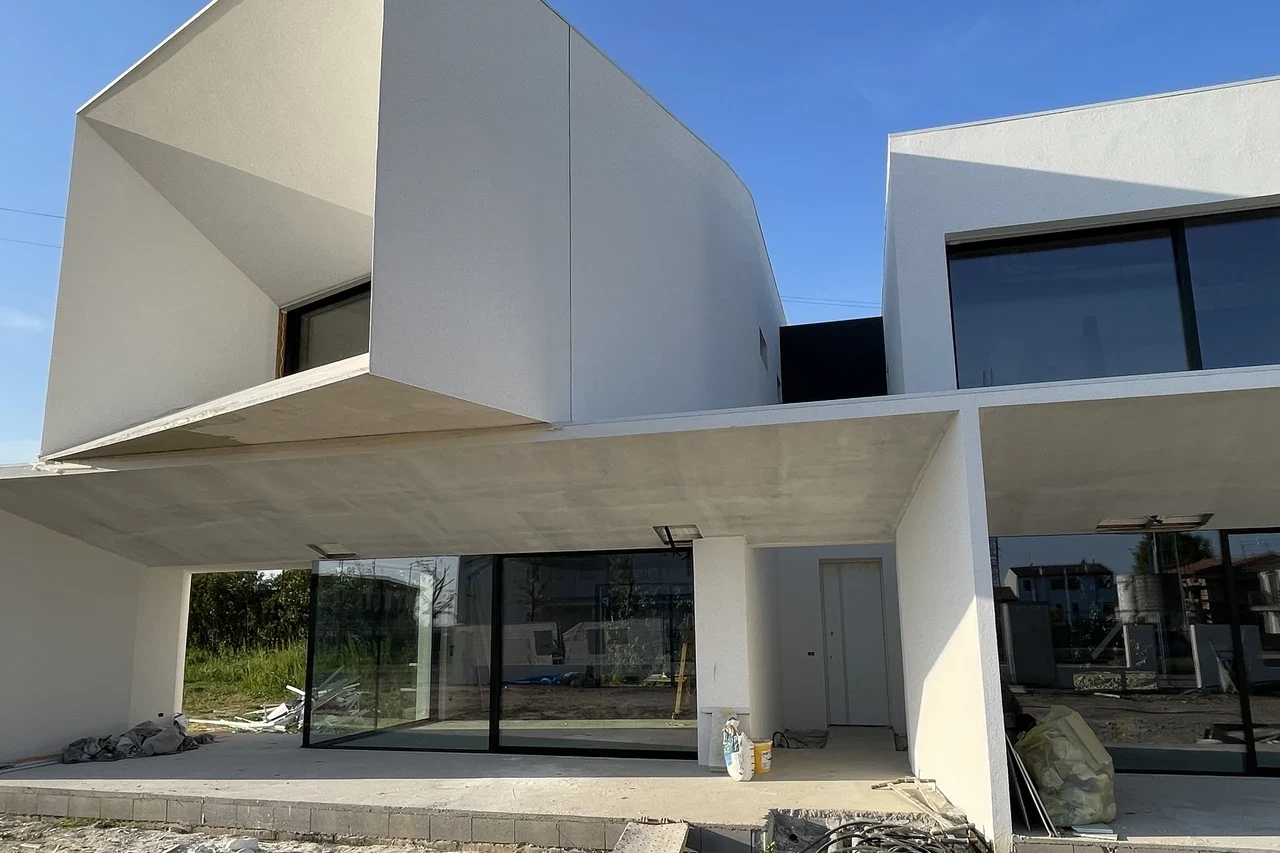
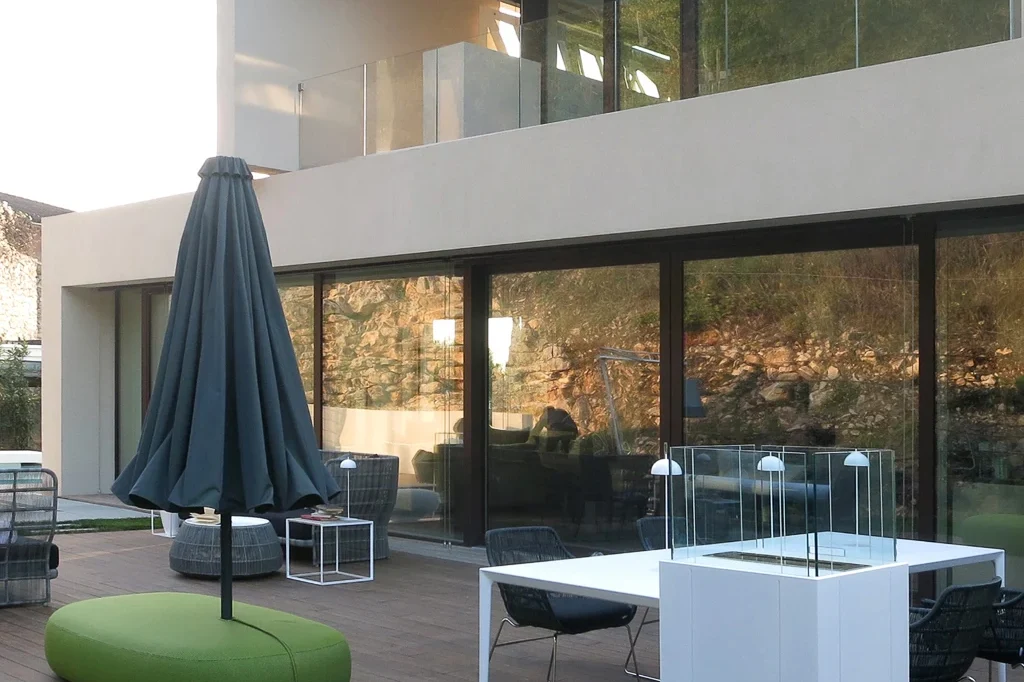
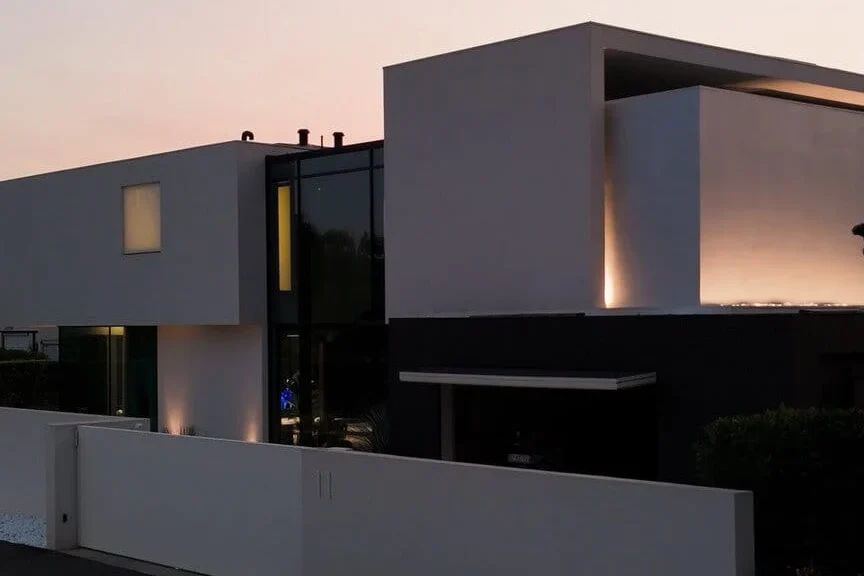
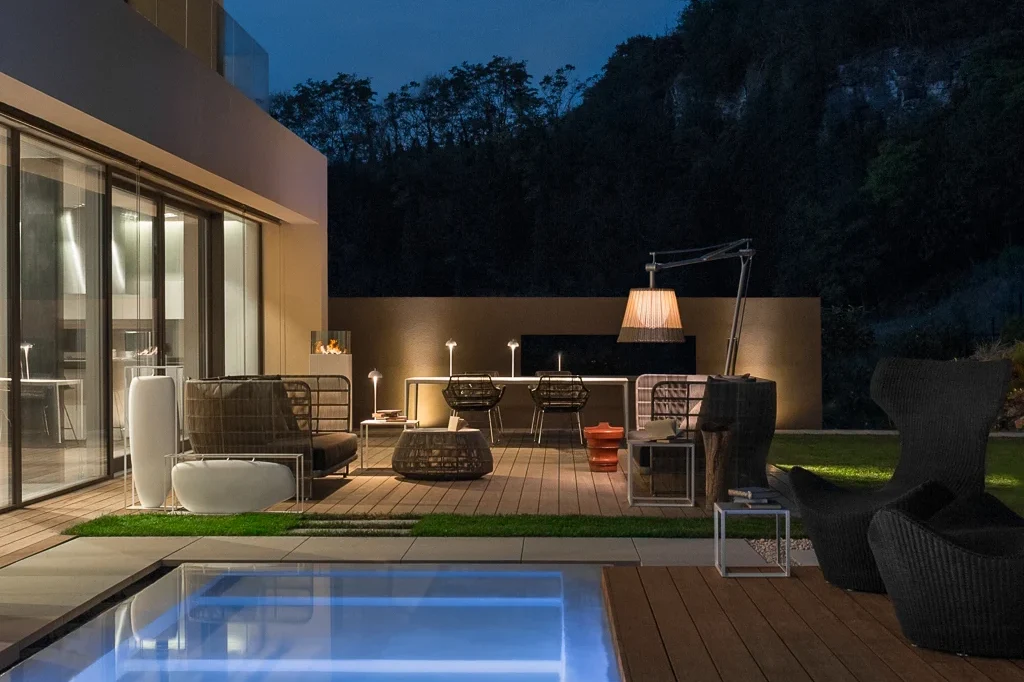
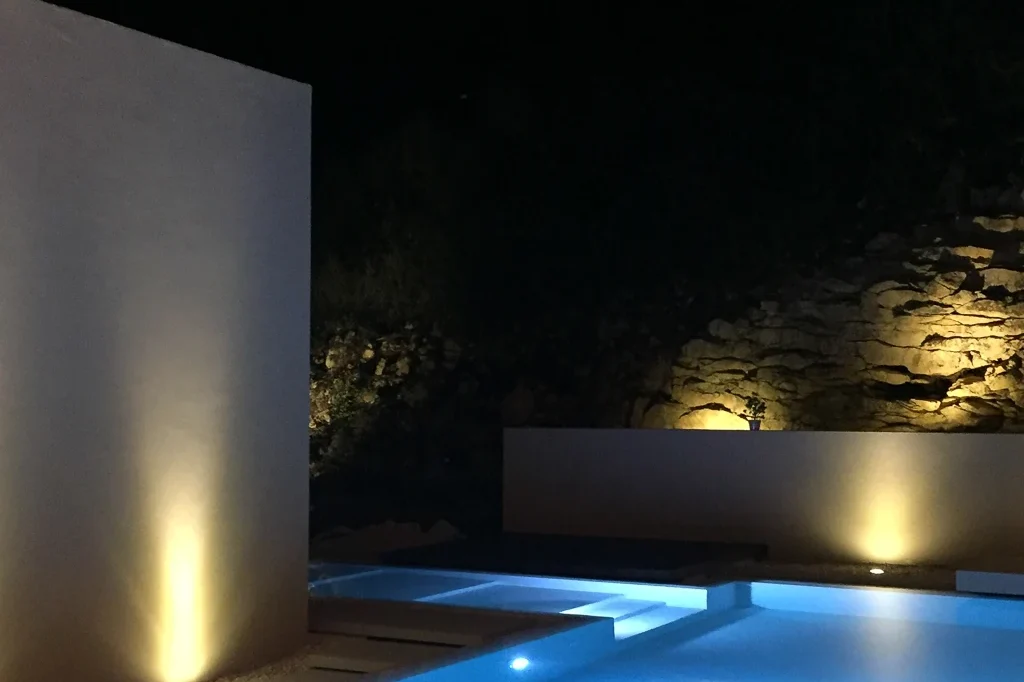
A note: the photos in this guide show gardens, exteriors and pools from the studio’s projects, and none is a natural swimming pool. We chose them because they show the relationship between house, water and landscape from which a project of this kind starts. For the related topics see our guides to the infinity pool and the green roof: in both cases water and planting become part of the architecture.
Natural swimming pool: eight mistakes to avoid
- Designing it as a pool without chlorine, with no treatment area.
- Shrinking the planted surface to gain garden.
- Using filling water whose phosphate has not been measured.
- Planting large trees next to the pool.
- Letting the ground drain towards the water.
- Not providing access for the maintenance of filters and pumps.
- Forgetting shade and summer water temperature.
- Not checking permits and constraints before the design.
The natural swimming pool, unlike almost any other element of the villa, does not forgive a rough design: mistakes show in summer, in the form of green water.
Invest
Infinity pool for a villa in Italy, explained by architects: building permit, position, overflow…
Natural swimming pool compared with a conventional pool
The choice between the two is not a matter of fashion but of time and attention: the table sets them side by side without naming a winner.
| Aspect | Natural swimming pool | Conventional pool |
|---|---|---|
| Water treatment | Biological: plants, substrate, circulation | Chemical and mechanical: filters and disinfection |
| Landscape | Soft surface, plants and gentle edges | Geometric basin, lining, technical edge |
| Maintenance | Monitoring algae, sludge, plants and water quality | Monitoring filters, pH and products |
| Seasonality | The system lives with the climate: restart and cold season must be managed | More predictable, winter cover |
| Design | Technical, hydraulic and botanical together | Structural and mechanical |
Invest
Solar battery storage for a villa in Italy, explained by architects with PVGIS data for Verona…
Natural swimming pool: frequently asked questions
What is a natural swimming pool?
It is a bathing pool cleaned biologically, with plants, substrate and a treatment zone, without chlorine. It behaves like a small ecosystem.
How much space does a natural swimming pool need?
More than a conventional pool: the treatment area is often at least as large as the swimming zone. Guidance for public sites speaks of 5 to 15 square metres of installation per square metre of use area; for a villa it is calculated case by case.
Is the water as clean as in a conventional pool?
It depends on the system and the care. The leaflet we read admits that at peak use the water is not always free of algae and germs, which is why it provides periodic checks.
Are chemicals needed?
The principle is not to use them for disinfection. What you need is phosphate-free filling water, plants, maintenance and checks.
Can a natural swimming pool be heated?
It can, but a higher temperature favours algae and germs: above 23 degrees the leaflet reports more Pseudomonas aeruginosa. It must be decided in the design.
What permits are required?
It depends on the municipality and the region. We have not verified the national rules, so our advice is to ask the technical office before designing and to check landscape constraints.
How much does a natural swimming pool cost?
We give no current figures. Surveys from 2005-2006 on public German sites showed lower construction costs and much lower running costs than conventional baths, but they are old data from another country.
Planning a villa with a garden in Italy?
Send us the site plan and photos of the garden: we tell you where a natural swimming pool would make sense, how much garden it takes and what to have checked by the landscape architect and the builder. For a complete project see Signature Architecture or write to us from Contact.
Sources: Umweltbundesamt, Regelwerke und Normen (FLL 2011 guideline on open-air pools with biological water treatment); Bavarian State Institute for Viticulture and Horticulture, leaflet «Schwimmteiche» (public installations; costs surveyed in 2005 and 2006). Checked on 9 November 2026; the leaflet’s data concern public installations in Bavaria. Photos: projects by Federico Cappellina Architects, which do not show a natural swimming pool.
Would you like an opinion on the project?
Send us the site plan and photos of the garden: we reply with the points to verify.
Discover the UHNW Lifestyle
The Villa Edit: materials and systems read by architects.