
ELRE
Landscape lighting design for a villa: an architect's guide to light in the garden
Landscape lighting design: how layers of light are planned, how trees, walls and water are lit and how glare is avoided, explained by architects.
Landscape lighting design for a villa: how it is done
Landscape lighting design decides how a villa and its grounds exist after sunset. For many months of the year the garden is seen more in the evening than by day: from the large windows of the living room, from the terrace, from the drive. Well-designed light extends the house outdoors, makes paths legible and gives the landscape depth; light placed at random flattens everything, dazzles, attracts insects and spoils the view of the sky. It is an architectural project, not a choice of fittings from a catalogue.
The pages Google shows for this search are mostly lighting companies and idea galleries. We do something else: we explain, as architects working on villas in Italy, how the landscape lighting of a villa is planned, which layers of light are needed, which techniques to use with trees, walls and water, how to choose the colour of light and which mistakes we see most often. We do not sell fittings, cite brands or give prices, because without a design they would be invented numbers.
Landscape lighting design in brief
- Less light, better placed: darkness is as much part of the design as light.
- Four layers: wayfinding, accent, living spaces, security.
- Warm, shielded light: you see the effect, not the source.
- Look from inside: at night the lit garden is the picture framed by the windows.
- Cables, scenes and controls are decided with the garden design, before the lawns.

The Villa Edit
Materials and systems of the villa
Natural swimming pool
The guide
Outdoor kitchen
The guide
Floor to ceiling windows
The guide
Brise soleil
The guide
Preliminary reading
Understand a villa before you buy it
Signature Architecture
Design or renovate a villa
Contact
Write to us
Landscape lighting design: the four layers of light
The clearest way to approach landscape lighting design for a villa is to think in layers, as in an interior. Each layer has a different task and they are not all switched on together: a weekday evening, a dinner on the terrace and an empty villa in winter call for different light. The table summarises the four layers we use in our projects.
| Layer of light | What it is for | How it is achieved |
|---|---|---|
| Wayfinding light | Reading paths, steps, entrances, pool edges | Step lights, low bollards, grazing light at ground level |
| Accent light | Giving the garden depth: trees, walls, sculptures, facades | Adjustable spotlights in the ground or in trees, light from below or above |
| Light for living spaces | Using terraces, pergolas, the outdoor kitchen, the dining area | Soft, dimmable light, wall lights, concealed strips, portable lamps |
| Functional and security light | Gates, driveways, the shaded sides of the villa | Light switched by sensors or scenes, always warm and shielded |
In landscape lighting design the most important layer is often the most discreet: wayfinding light. Steps, level changes and the edges of pools must be legible without the garden looking like a runway. Then comes accent light, which builds depth: a few well-lit trees, a stone wall, a facade. The living-space layer must be dimmable, because a dinner wants less light than drinks before it. Security light, finally, comes on only when needed.
Explore our projects
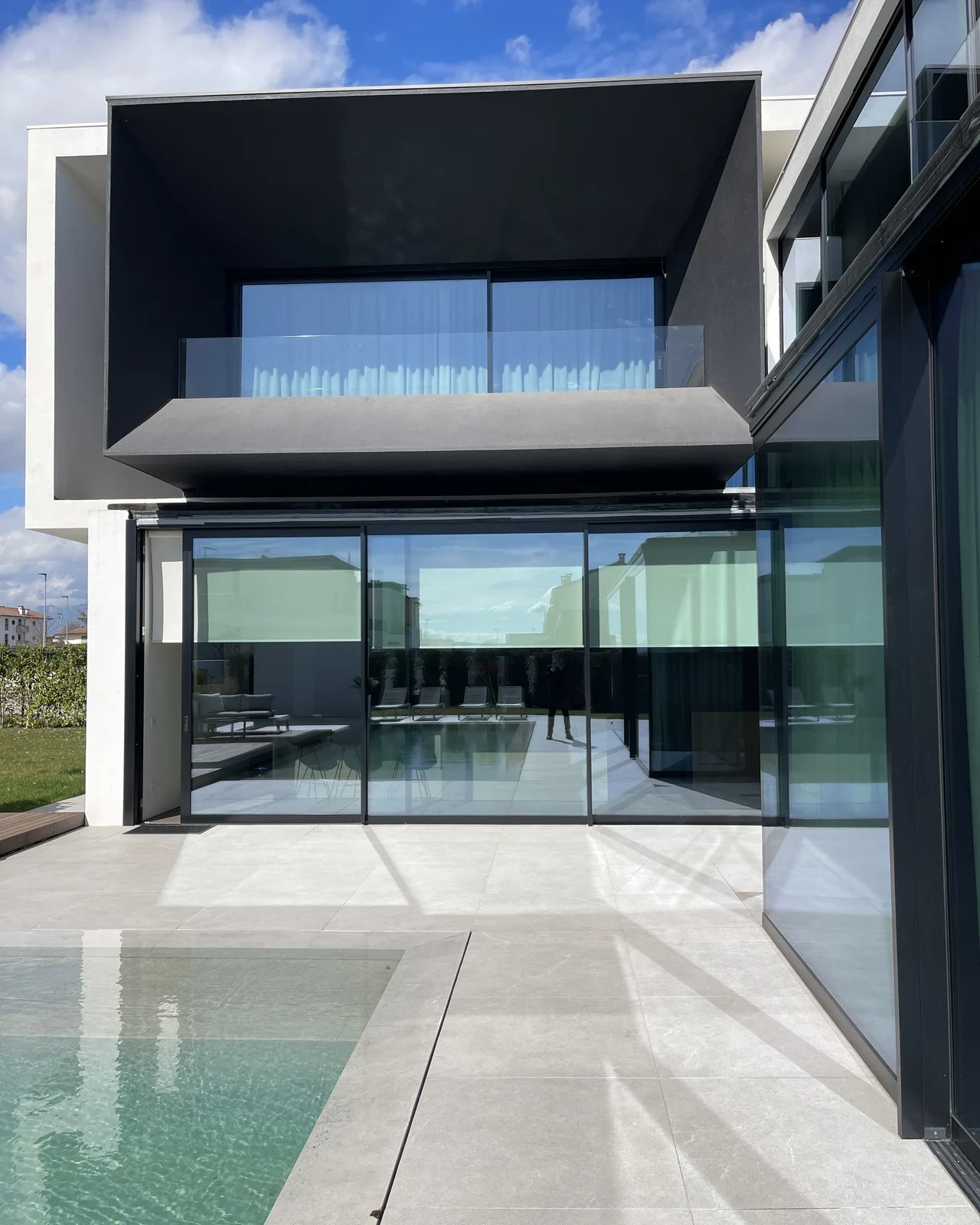
Metra glazing, Viabizzuno and OTY lighting, infinity pool: design and site direction by the studio.
Landscape lighting design and the architecture of the villa
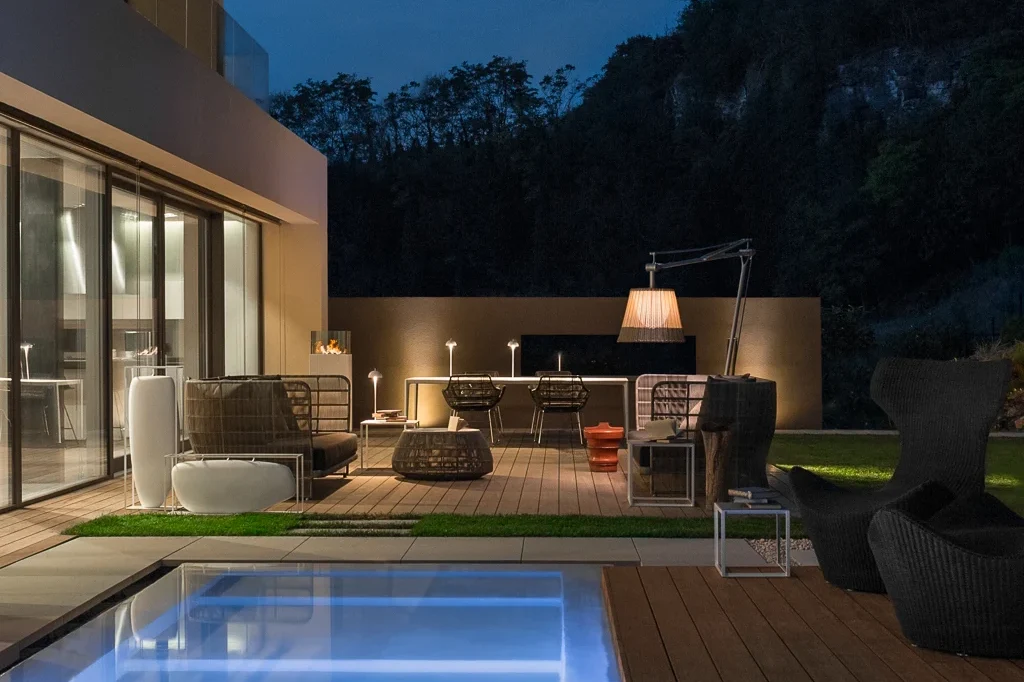
The first viewpoint of landscape lighting design is inside the house. From the floor to ceiling windows of a living room at night you see the room reflected in the glass, unless there is enough light outside to break through the reflection. That is why we always light something in front of the large openings: a tree, a wall, the edge of a pool. The garden becomes the picture of the house even in winter, when nobody goes out.
The second viewpoint is the arrival. The drive, the gate and the front door introduce the villa to anyone arriving at night. Here light must guide without dazzling, with low fittings along the paths and an accent on the facade or on a tree marking the entrance. The third viewpoint is from afar: a villa on a hillside or a lake is seen from the landscape, and too much light turns it into a lighthouse.
Landscape lighting design: trees, walls and water
The same fittings give very different results depending on how they are aimed. The table summarises the techniques we use most often in landscape lighting design and where they work best.
| Technique | Effect | Where we use it |
|---|---|---|
| Uplighting | Draws trunks and canopies, creates volume | Single trees, olive trees, stone walls |
| Moonlighting (downlighting) | Light filtered through leaves, soft shadows on the ground | Large trees above lawns and paths |
| Grazing light | Brings out the texture of surfaces | Stone walls, hedges, textured facades |
| Backlighting and silhouette | Detaches shapes from the background | Sculptural plants in front of a light wall |
| Light reflected in water | Doubles the landscape and calms the view | Reflecting pools, swimming pools, natural pools |
Trees are the most rewarding elements to light. An olive tree lit from below becomes a sculpture; a large tree with a fitting mounted high and aimed down produces the moonlight effect, with leaf shadows on the lawn. Water is the other great ally: a natural swimming pool or a reflecting pool softly lit at the edge reflects trees and sky and doubles the depth of the garden. A pool lit too strongly, on the other hand, becomes a blue stain that switches off everything around it.
Invest
Natural swimming pool for a villa in Italy, explained by architects: areas, water treatment…
Explore our projects

Schüco glazing, Minimal Cucine and Modulnova kitchen, Poliform and Baxter furniture, Occhio lighting, MAFI wood.
Landscape lighting design: colour and quantity of light
In the landscape lighting design of our projects we almost always use warm light, around 2,700-3,000 kelvin, which respects the colours of stone, timber and plants. Cold, white or bluish light makes a garden artificial and leaves grey. Coloured light we avoid, save in very rare cases. Quantity matters just as much: outdoors the eye adapts to darkness and very low light levels are enough to see well. Doubling the output does not improve the scene, it flattens it.
Colour rendering varies from one fitting to another: ask for the data sheets and, if possible, a trial on site, at night, with two or three fittings aimed at the real trees. It is the surest way to settle the landscape lighting design: a light that looks perfect in a catalogue can turn out far too strong under an olive tree.
Glare, light pollution and neighbours
Good landscape lighting design is recognisable because the sources cannot be seen: you see the effect of light on trees, walls and paths. Shielded fittings, carefully aimed and recessed where possible, avoid glare for people walking and for those looking out from the house. Upward light should be kept to a minimum, both out of respect for the night landscape and because many Italian regions have laws against light pollution: the designer checks the one in force in your region and the municipal regulations.
Light must not enter the neighbours’ homes or shine onto the road. On lakes, hillsides and in the countryside, where the darkness of the landscape is part of its value, a villa lit with restraint is worth more than one lit like daytime.
Explore our projects
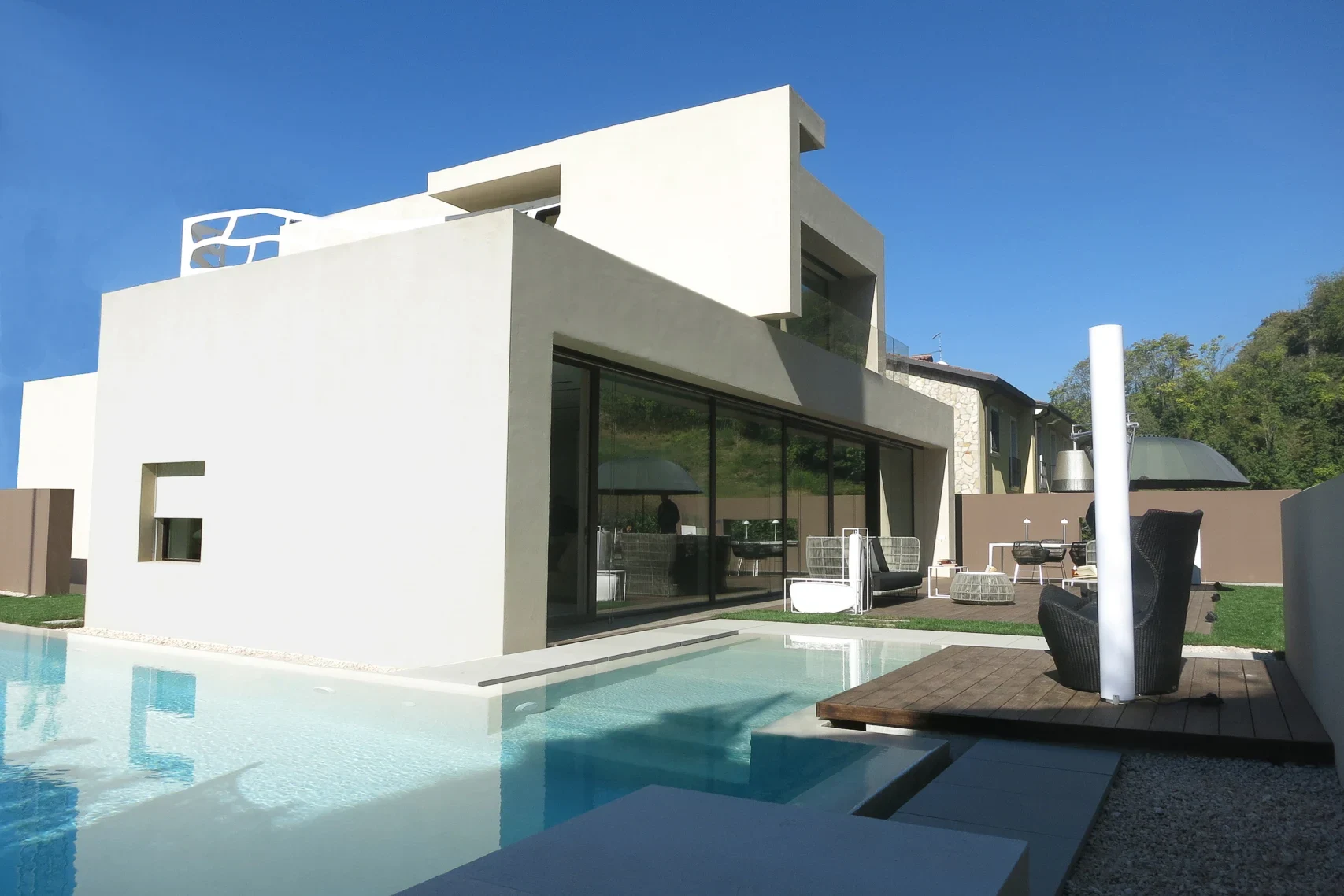
Edra sofas, Varenna kitchen, Noorth and Agape bathrooms: a studio project.
Landscape lighting design for outdoor living
Outdoor living spaces call for light closer to that of an interior. Under a pergola, dimmable light strips can be integrated into the louvres or beams; an outdoor kitchen needs functional light on the worktop and softer light on the table. Rechargeable portable lamps, set on a table or a low wall, add a low, warm light no fixed system can replace.
On terraces it is best to avoid wall-mounted floodlights aimed downwards, which dazzle seated guests and draw insects to eye level. Low lights, shielded wall fittings and light-coloured surfaces reflecting indirect light work better. Shading elements such as a brise soleil can also hide linear fittings and wash the facade with light.
Landscape lighting design: wiring, controls and scenes
Landscape lighting design must go hand in hand with the garden design, before lawns and paving are laid. The design shows the position of every fitting, cable routes, pits, separate circuits for the layers of light and control points. Outdoor fittings must have a protection rating suited to their position, as stated by the manufacturer, and the installation must be carried out by a qualified electrician, with the protections required for outdoor systems.
Scenes make any landscape lighting design simpler to live with: ‘arrival’, ‘dinner’, ‘night’, ‘villa empty’. They can be run by an astronomical timer, presence sensors or the home automation system. Our advice is to keep a few clear scenes, always with a manual switch: a garden that lights itself at the wrong moment soon becomes tiresome.
Invest
Outdoor kitchen design for a villa: layout, cover, masonry or stainless steel, worktops, services…
Architecture
UHNW luxury villa architecture designed and supervised by Federico Cappellina’s studio since 2002…
Landscape lighting design on a lake, a hillside or in town
The place changes the design. In a lakeside villa the night landscape is made of water and reflections: landscape lighting design must keep light low towards the shore, so as not to erase the reflection of distant lights and not to disturb anyone looking from the water.
On a hillside, among vineyards and olive groves, the villa is seen from far away and very little is needed to mark it: a few lit trees, the paths, a facade barely touched by light. In town, or in a narrow walled garden, light serves to expand space: lighting the end wall or a plant against a light wall makes the garden feel deeper.
Maintaining a landscape lighting design
A garden grows; light does not. Every year it is worth re-aiming the spotlights on trees that have spread, cleaning the glass of in-ground fittings covered with soil and leaves, and checking the pits after heavy rain. In-ground fittings must be reachable by the mower without being hit, and those among plants should not disappear under roots or hedges within a few years. Ask the designer for an updated lighting plan: in five years it will be the only way to know where the cables run.

Invest
Floor to ceiling windows for a villa in Italy, explained by architects: types, sun and shading…
Landscape lighting design in our projects
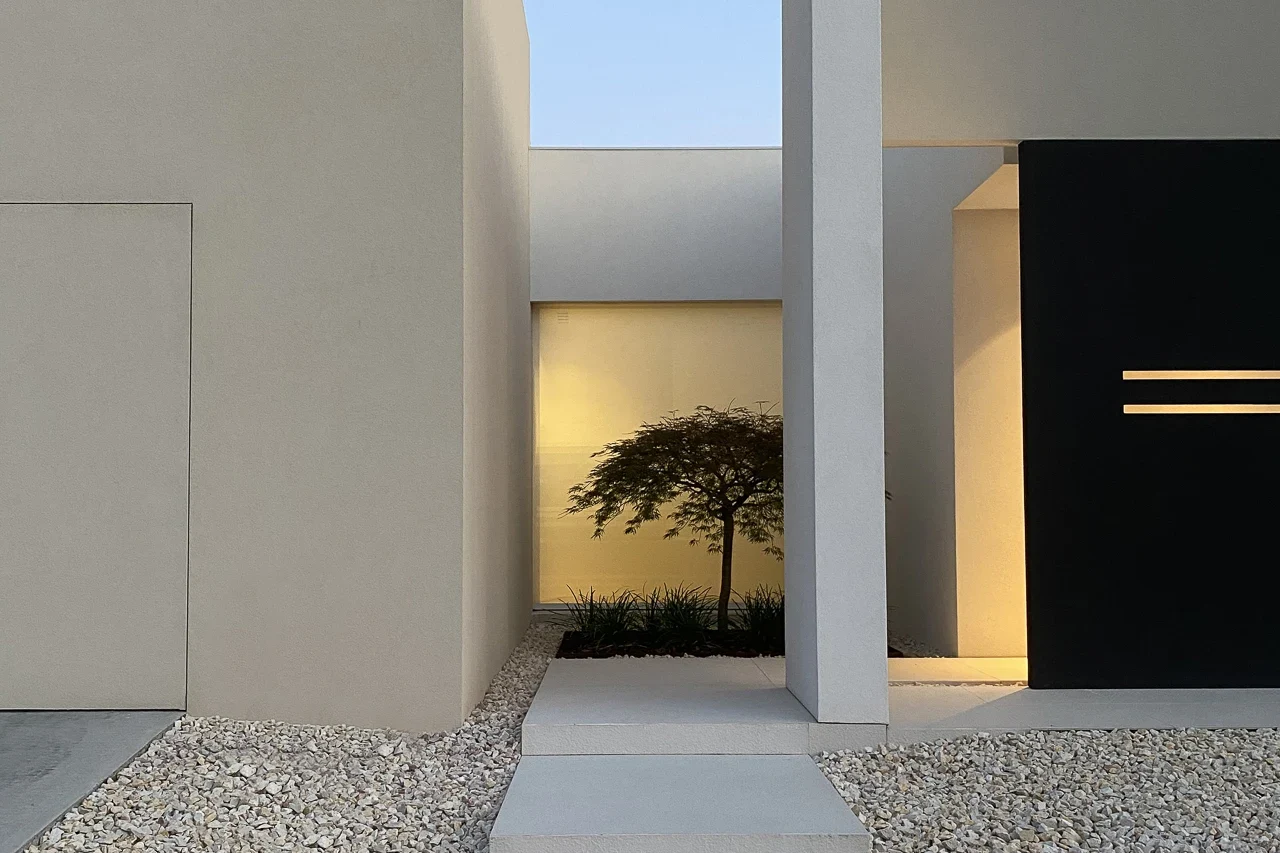
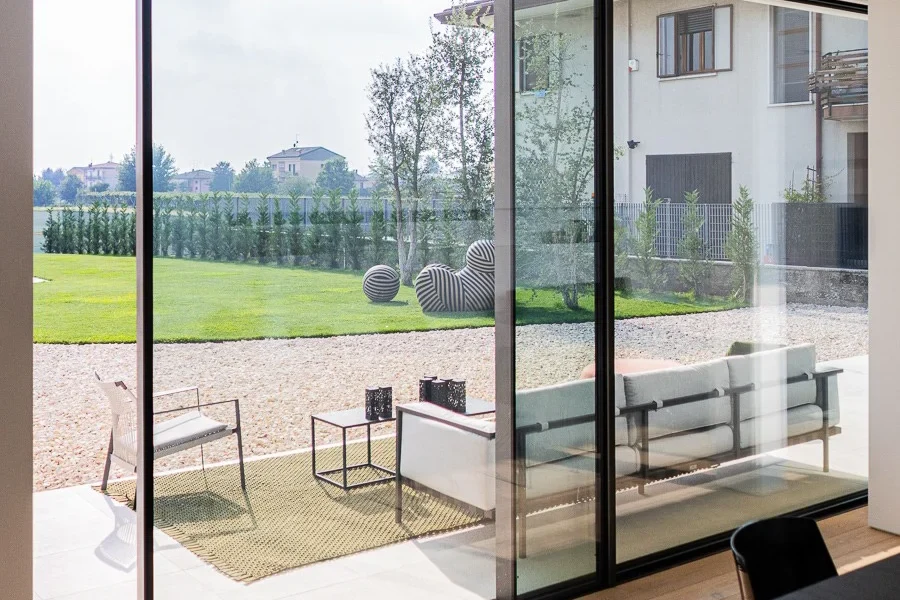
A clarification: the photos in this guide show exteriors and interiors of projects by Federico Cappellina Architects, and they do not document outdoor lighting installations. We chose them because they show the relationship between house, glazing and landscape from which a landscape lighting design starts. For related topics see the guides to the natural swimming pool, the outdoor kitchen and floor to ceiling windows.
How much landscape lighting design costs
We give no figures, because the cost of landscape lighting design and installation depends on the area, the number of trees and features to light, the quality of the fittings, trenching and cabling, controls and scenes. Ask for quotes that separate lighting design, fittings, trenching and cable laying, panels and controls, testing and final aiming, so that you compare truly similar offers.
The advice remains the same: spend on the design and on the final aiming, at night, on site. That is where a few well-chosen fittings turn a landscape lighting design into a night landscape.

Invest
Before buying a luxury villa in Italy, the Dominican Republic, Zanzibar or Dubai: send us the…
Landscape lighting design: eight mistakes to avoid
- Lighting everything evenly, with no areas of darkness.
- Using cold or coloured light that makes greenery look artificial.
- Leaving the sources visible, causing glare.
- Aiming light at the sky, the road or the neighbours.
- Forgetting the view from inside, through the windows.
- Laying cables and pits after the lawns, without a design.
- One switch for the whole garden.
- Never re-aiming the lights as the trees grow.
Landscape lighting design: frequently asked questions
What does landscape lighting design for a villa involve?
Working in layers: wayfinding light on paths, accents on trees and walls, dimmable light in living spaces and security light only when needed, starting from the view from inside.
What colour of light suits landscape lighting design?
In our projects warm light, around 2,700-3,000 kelvin, which respects stone, timber and plants. Cold and coloured light makes a garden look artificial.
How are trees lit?
With uplighting to draw trunk and canopy, or with downlighting from high in the tree for a moonlight effect, using shielded, carefully aimed fittings.
How is light pollution avoided?
With shielded fittings, little upward light, low levels and scenes that switch off when not needed. The designer checks regional law and municipal rules.
Is a landscape lighting design really needed?
Yes: positions, cables, pits, separate circuits and controls should be decided before lawns and paving, together with the garden design.
Can a landscape lighting design be linked to home automation?
Yes, with scenes such as arrival, dinner, night and villa empty, always keeping a manual control.
How much does landscape lighting for a villa cost?
It depends on area, features to light, fittings, trenching and controls. We give no figures without a design: ask for quotes separated by item.
Architecture
Luxury interiors for villas: the 12 systems of The Villa Edit, from passive house to furniture…
Invest
Brise soleil for a villa in Italy, explained by architects: origin, orientation, types, fixed or…
Designing or renovating a villa in Italy?
Send us the plan of the house and garden: as part of the landscape lighting design we tell you what to light, from which viewpoints and what to have checked by the lighting designer and the installer. For a complete project see Signature Architecture or write to us from Contact.
Note on sources: this guide reports the studio’s design practice (layers of light, aiming techniques, the colour temperature used in our projects). We do not cite technical standards, numeric protection ratings or specific regional laws, which we did not consult for this guide, nor prices or brands. Updated on 11 November 2026. Photos: projects by Federico Cappellina Architects, which do not show outdoor lighting installations.
Would you like an opinion on the project?
Send us the plan of house and garden: we reply with the points to verify.
Discover the UHNW Lifestyle
The Villa Edit: exteriors and systems read by architects.