
ELRE
Home security system for a villa: an architect's guide to protection, cameras and automation
Home security system: how a villa’s rings of protection are designed, how cameras, home automation and light are integrated and who responds, explained by architects.
Home security system for a villa: how it is designed
A home security system for a villa is not a box added once the works are finished. It is a system designed together with the architecture: it depends on how many doors and glazed openings the house has, how the garden is laid out, where people sleep, how long the villa stays empty during the year and who must respond when the alarm goes off.
A villa with large openings onto the landscape, a park and a gate far from the house has very different needs from a city apartment, and it calls for a real design.
The pages Google shows for this search are mostly from manufacturers, installers and monitoring services. We do something else: we explain, as architects working on villas in Italy, how a home security system is planned, which layers of protection exist, how to choose between wired and wireless, how it works with home automation and garden lighting, and which mistakes we see most often. We do not sell systems, cite brands or give prices, because without a design they would be invented numbers.
Home security system in brief
- Protection is built in rings: garden, villa envelope, interior, sensitive rooms.
- Perimeter first: in an occupied villa it is better to know someone is trying to get in before they are inside.
- Wired or wireless is decided with the building works: in new villas the cables belong in the design.
- Cameras are there mainly to verify an alarm, not to film everything.
- Who responds matters as much as the sensor: owners, neighbours, a monitoring company.
The Villa Edit
Materials and systems of the villa
Home automation
The guide
Landscape lighting
The guide
Floor to ceiling windows
The guide
Outdoor kitchen
The guide
Preliminary reading
Understand a villa before you buy it
Signature Architecture
Design or renovate a villa
Contact
Write to us
Home security system: the four rings of protection
The clearest way to design a home security system for a villa is to think in concentric rings. Each ring has a different task and different devices; not all are needed in every house, but it is worth knowing they exist and choosing consciously which to use. The table summarises them.
| Ring | What it protects | Typical devices |
|---|---|---|
| Outer (plot boundary) | The garden, gates and drives: it signals someone entering the property before they reach the house | Infrared beams, outdoor detectors, gate sensors, cameras with video analytics |
| Perimeter (villa envelope) | Doors, windows, glazing, rooflights: it signals an attempt to open or force them | Magnetic contacts, vibration or glass-break sensors, monitored shutters |
| Volumetric (interior) | Rooms and unavoidable passages: it signals someone moving inside the house | Motion detectors, dual-technology sensors, ceiling sensors |
| Sensitive rooms | Safe, wine cellar, study, plant room | Dedicated sensors, security doors, a separate zone in the programme |
In the home security system of the studio’s villas the priority almost always goes to the perimeter ring: monitored doors, windows and glazing allow the system to stay armed at night, with people at home, without the limits of volumetric sensors. The outer ring makes sense when the plot is large and the house is far from the gate, but it must be designed carefully, because a garden is full of movement: animals, branches, leaves, irrigation. The inner rings matter mostly when the villa is empty.
Explore our projects
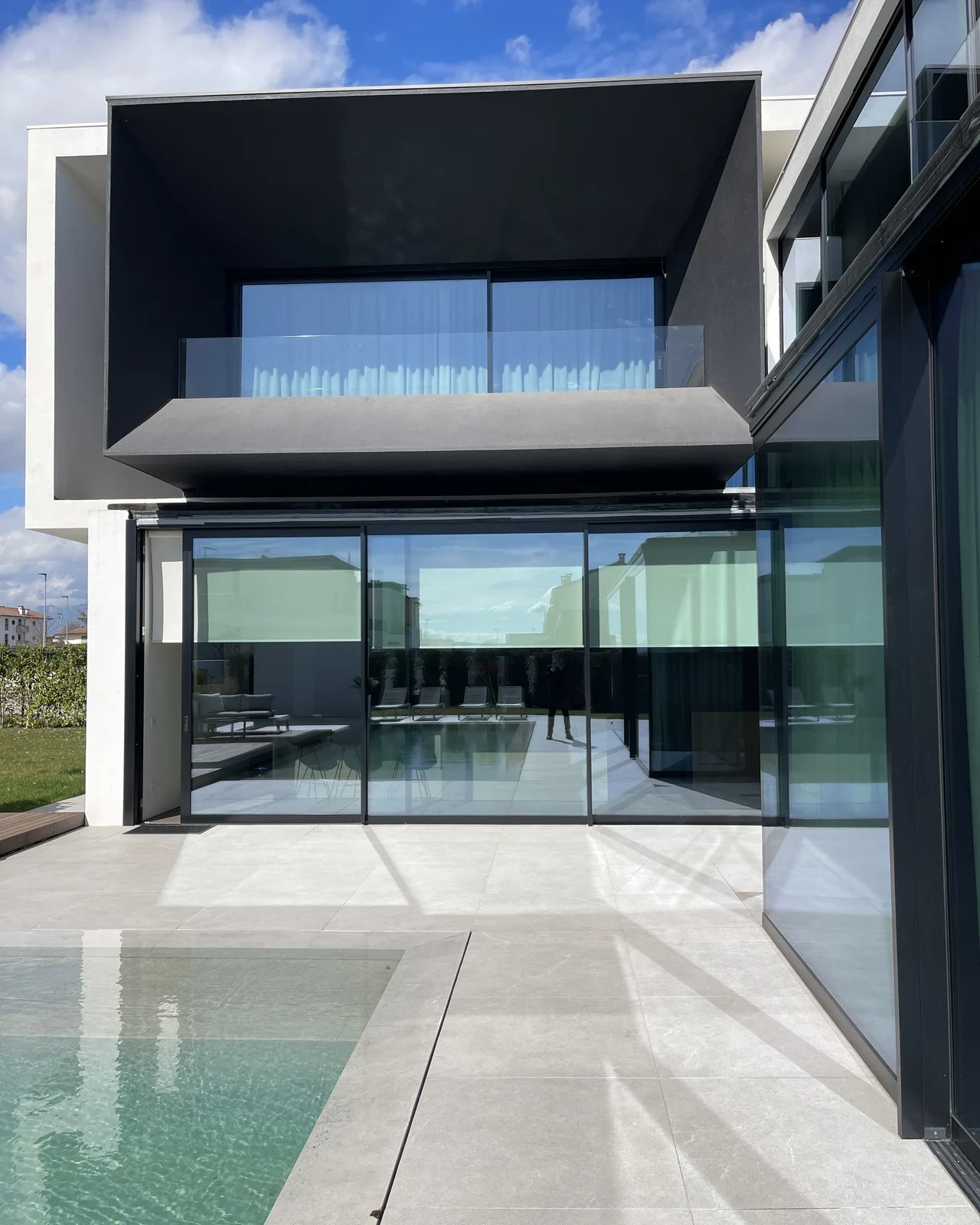
Metra glazing, Viabizzuno and OTY lighting, infinity pool: design and site direction by the studio.
Home security and architecture
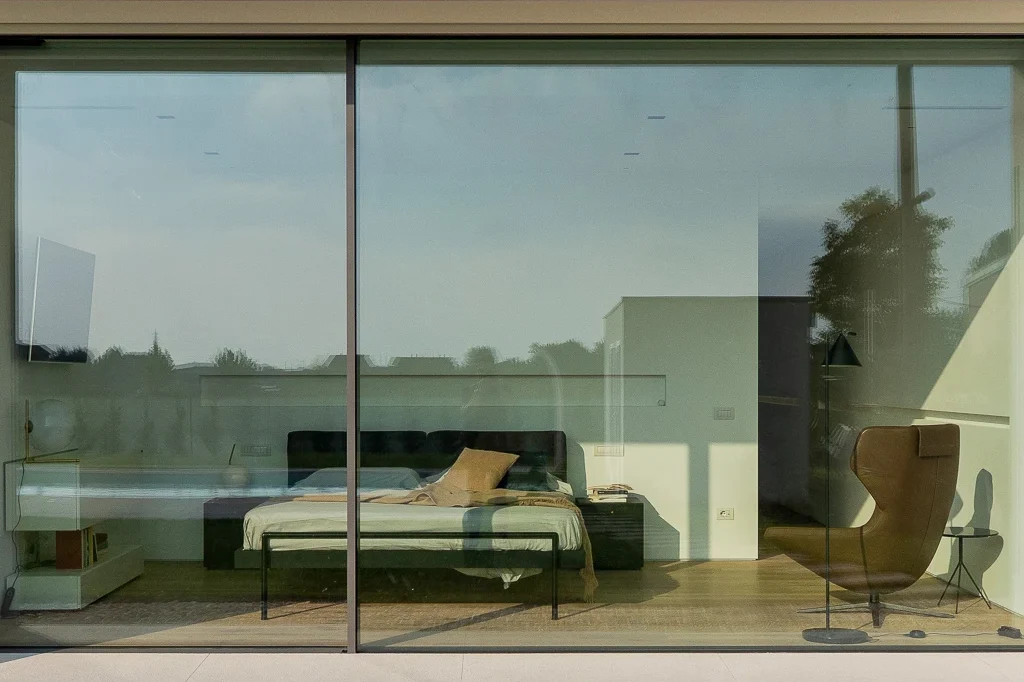
A contemporary villa often has large floor to ceiling windows, lift-and-slide doors and French windows on every side. They are its quality and also the points to protect. A well-designed home security system uses contacts and sensors integrated invisibly into the frames, monitors sliding leaves and shading systems too, and takes into account how the house is really lived in: which doors stay open in summer, which rooms are occupied at night, where children move.
The position of the components matters too. The control panel and the back-up power supply belong in a protected room, not next to the entrance. Keypads go where people really come in, often from the garage rather than the front door. External sirens are visible and must be placed with the same rigour as a light fitting or a vent grille: on a carefully drawn facade, an object placed at random spoils the elevation.
Wired or wireless home security system
The choice between a wired and a wireless home security system is made with the building works. In a new villa or a full renovation the cables are laid in chases before plastering, cost little in proportion and give a stable system with no batteries to change. In an occupied house, where opening the walls would mean ruining finishes and floors, a good wireless system is the reasonable solution. A mixed system is common: wired where it is easy, wireless at the difficult points.
| Choice | Option A | Option B | How to decide |
|---|---|---|---|
| Connection | Wired (cables in chases) | Wireless (radio) | New villa or full renovation: wired. Occupied house, light works: good-quality wireless |
| Alarm response | Siren and alert to the owner | Connection to a monitoring and patrol company | Villa used only part of the year or isolated: monitoring matters more than the siren |
| Verification | Sensors only | Sensors plus verification cameras | Images reduce false alarms and unnecessary call-outs |
| Control | Keypad and fob | App and integration with home automation | Integrate only if the network is designed and protected |
Whatever the choice, the home security system should be drawn on the villa’s plans, with the position of every sensor, the control panel, keypads and cameras. It is the same work done for the electrical system and for home automation: if it comes late, the cables are missing exactly where they would be needed.
Explore our projects

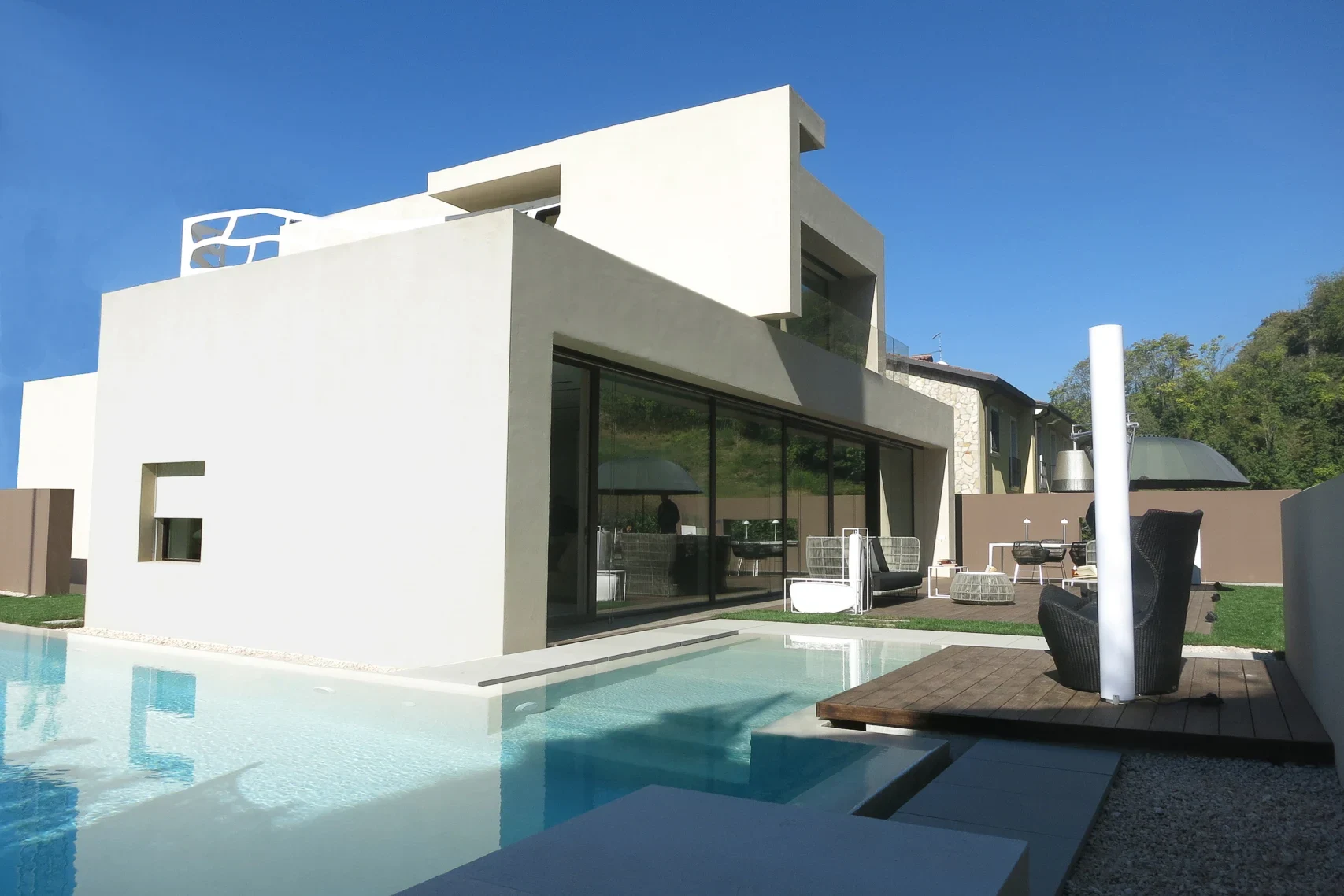
Schüco glazing, Minimal Cucine and Modulnova kitchen, Poliform and Baxter furniture, Occhio lighting, MAFI wood.

Invest
Outdoor kitchen design for a villa: layout, cover, masonry or stainless steel, worktops, services…
Home security system cameras and video surveillance
In a well-planned home security system, cameras serve one main purpose: verification. When a sensor signals an intrusion, being able to see what is happening makes it possible to tell a real attempt from a cat or a branch, and to call the monitoring company or the police only when needed. Cameras everywhere that nobody watches produce many images and little security.
Recording affects the privacy of residents, guests, staff and people passing the property. The general principle is to frame only your own spaces, avoid the street and other people’s property, and inform those entering the recorded areas. We do not set out detailed rules here, as they depend on the case: the installer should indicate them and, in Italy, the reference is the guidance of the Italian data protection authority (Garante per la protezione dei dati personali).
Home security and home automation
In many villas the home security system talks to home automation: when it is armed, shutters close and lights switch off; when the villa is empty, some lights come on at varying times; in an alarm, the garden lights up. These are useful functions, but they must be designed with care. Security must remain an autonomous and reliable system even if the home network stops, and the network itself must be protected, with separate access and strong passwords, because a system connected to the internet is also a way in.
Our advice is simple: integration yes, dependence no. The control panel of the home security system must work on its own, with its back-up power and its own communication channel; home automation can read its status and react, but not replace it.
Explore our projects
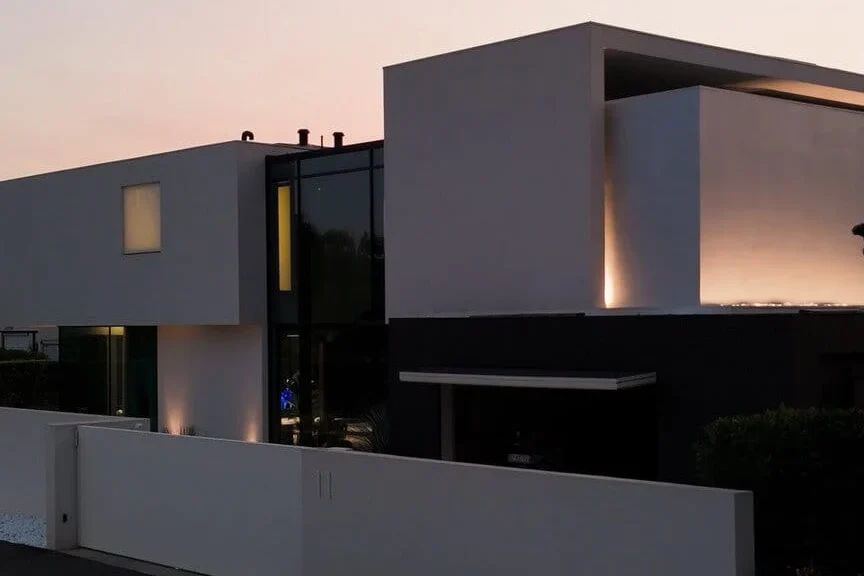
Edra sofas, Varenna kitchen, Noorth and Agape bathrooms: a studio project.
Home security system, light and the garden
Light is one of the most effective and least intrusive deterrents. Well-designed landscape lighting makes paths, entrances and the sides of the villa that stay in shadow at night legible, without turning the house into a floodlit car park. Some fittings can switch on with presence sensors or with the home security system; most remain a warm, low light that follows the landscape.
Planting plays a part in security as well. Tall hedges close to ground-floor windows offer cover to anyone wanting to get in unseen; a boundary wall that is too low or a gate easy to climb make even the most sophisticated home security system useless. When designing the garden, it pays to look at the villa through the eyes of someone who wants to break in.
Who responds when the home security system goes off
A home security system is worth as much as the response it triggers. In a villa occupied all year, the siren and an alert on the owners’ phones may be enough. In an isolated house, or one used only in summer, nobody hears the siren: a connection to a monitoring company is needed, with agreed keys and procedures, or at least a network of trusted people who can check. It is a management decision more than a technical one, and it should be taken together with the design.
Always ask for a clear maintenance and service contract: who checks the system, how often, who answers in case of a fault and how quickly. An unmaintained home security system produces false alarms, and a home security system that often goes off for nothing ends up switched off.

Invest
KNX home automation for a villa in Italy, explained by architects: wired or wireless, scenes…

Home security when renovating a villa
When renovating an existing villa, the home security system is the opportunity to rethink the whole security of the house: windows, entrance doors, gates, lighting and the system itself. Often the weak points are not the sensors but old windows, useless and unattractive bars, forgotten service doors. Replacing windows with more resistant models and planning the contacts in the frames from the start gives a cleaner result than any later addition.
Home security system: frequent design mistakes
The home security system mistakes we see most often in villas are not about the quality of the sensors but about the design. The table summarises three typical ones, with their consequence and how to avoid them.
| Frequent mistake | Consequence | How to avoid it |
|---|---|---|
| Volumetric sensors in rooms with pets | Constant false alarms | Dedicated sensors or perimeter protection first |
| Cameras pointed at the street or the neighbours | Privacy problems | Framing limited to the property, information signs |
| Control panel in the entrance cupboard | Easy to reach and tamper with | Panel in a protected room, with back-up power |
Invest
Before buying a luxury villa in Italy, the Dominican Republic, Zanzibar or Dubai: send us the…
Home security in our projects
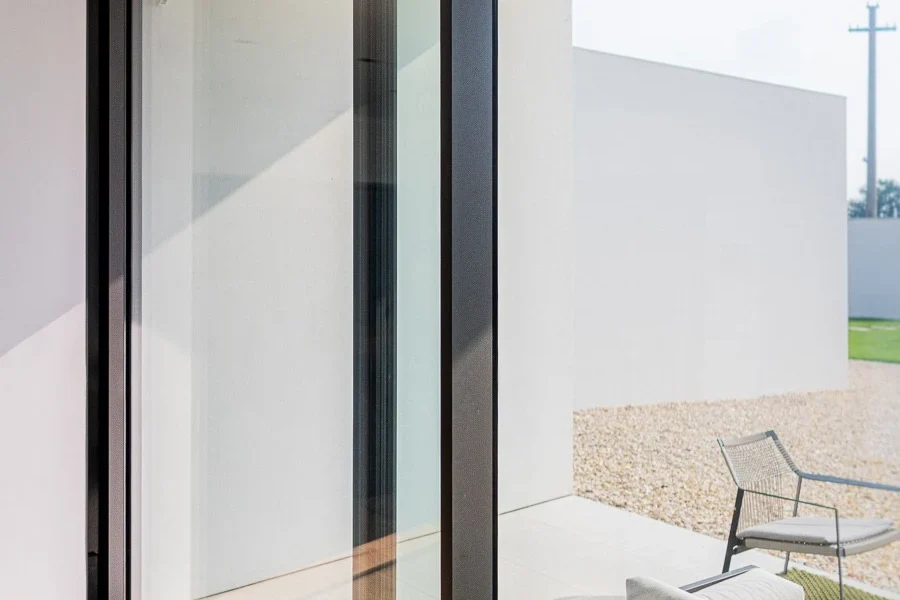
A clarification: the photos in this guide show exteriors and interiors of projects by Federico Cappellina Architects, and they do not document security systems. We chose them because they show the type of villa, with large openings and a garden, for which a home security system must be designed with the architecture. For related topics see the guides to home automation, landscape lighting design and the outdoor kitchen.
How much a home security system for a villa costs
We give no figures, because the cost of a home security system depends on the size of the villa, the number of openings, the rings of protection chosen, the type of connection, the cameras, the monitoring contract and maintenance. Ask for quotes that separate control panel and accessories, sensors per ring, cameras, installation and cabling, configuration, monitoring and annual maintenance, so that you compare truly similar offers.
The advice remains the same: spend on the design and on the points that protect the villa’s envelope. A home security system with few well-placed sensors and an organised response is worth more than many devices placed at random.

Architecture
Luxury interiors for villas: the 12 systems of The Villa Edit, from passive house to furniture…
Home security system: eight mistakes to avoid
- Planning the system after the works, when cables can no longer be laid.
- Relying only on volumetric sensors, which force you to switch everything off at night.
- Forgetting service doors, the garage, rooflights and sliding glazing.
- Placing the control panel by the entrance, without back-up power.
- Cameras recording the street and the neighbours.
- A siren nobody hears, with no monitoring or contact people.
- Integrating the alarm with an unprotected home network.
- No maintenance contract: false alarms and a system left off.
Home security system: frequently asked questions
What is a home security system?
It is the intruder alarm system of the house: sensors, control panel, keypads, sirens and, if planned, cameras and a monitoring connection, which detect and deter an attempt to get in.
Wired or wireless home security system?
In a new villa or a full renovation a wired system laid in chases is usually better. In an occupied house a good wireless system avoids opening walls and floors.
What is perimeter protection in a home security system?
It is the monitoring of doors, windows and glazing: it signals an attempt to open them before anyone is inside and lets the system stay armed with people at home.
Does a home security system need cameras?
They are useful mainly to verify an alarm and reduce unnecessary call-outs. They should frame only your own spaces, respecting privacy.
Can a home security system be linked to home automation?
Yes, to close shutters, switch on lights or send alerts. The control panel must however remain autonomous and the home network must be protected.
Do I need a monitoring company?
For an isolated villa or one used only at certain times, yes, because nobody would hear the siren. For a villa occupied all year an alert to the owners may be enough.
How much does a home security system for a villa cost?
It depends on size, openings, rings of protection, cameras and monitoring. We give no figures without a design: ask for quotes separated by item.
Invest
Floor to ceiling windows for a villa in Italy, explained by architects: types, sun and shading…
Architecture
UHNW luxury villa architecture designed and supervised by Federico Cappellina’s studio since 2002…
Designing or renovating a villa in Italy?
Send us the plan of the house and garden: we tell you where a home security system should protect first, where the cables run and what to have checked by the installer. For a complete project see Signature Architecture or write to us from Contact.
Note on sources: this guide reports the studio’s design practice and the general principles of intruder alarm systems. We do not cite product or installation standards or security grades, which we did not consult for this guide, nor prices, brands or incentives. For video surveillance in Italy the reference is the Italian data protection authority (Garante per la protezione dei dati personali). Updated on 11 November 2026. Photos: projects by Federico Cappellina Architects, which do not show security systems.
Would you like an opinion on the project?
Send us the plan of house and garden: we reply with the points to verify.
Discover the UHNW Lifestyle
The Villa Edit: systems and services read by architects.