
ELRE
Resin flooring for a villa: an architect's guide to substrate, joints and installation
Resin flooring: types of resin, screed, joints, slip resistance and site safety, explained by architects.
Resin flooring for a villa: where it works and how it is designed
Resin flooring is the most coherent choice for anyone who wants a continuous surface in a villa, with no joints, from the living area to the bathroom. Its appeal is architectural: a single surface that accompanies the spaces without interruption, in colours from warm grey to matt white.
But resin flooring is a system of thin layers that depends entirely on what lies below it, and its result is decided in the screed, in the joints and in the execution, not in the shade chosen from a sample. That is why resin flooring is designed with the building site, not ordered from a catalogue.
Most pages that Google shows for this search are guides to pros, cons and costs. We do something else: we explain, as architects, where resin flooring is the right choice in a villa, what is known from official sources about the materials and where problems begin. We do not sell systems, we do not cite brands and we do not give prices per square metre, because without a design they would be invented numbers.
Resin flooring at a glance
- The substrate decides: a flat, dry, crack-free screed before any resin.
- The type of resin changes hardness, elasticity, look and safety on site.
- Joints must be decided in the design: a continuous surface cracks where the structure moves.
- Slip resistance is chosen room by room: a bathroom or an outdoor area does not want the same finish as the living area.
- The installer matters as much as the material, and for some resins must have specific training.
The Villa Edit
Materials and systems of the villa
Underfloor heating
The guide
Hardwood flooring
The guide
Walk-in shower
The guide
External wall insulation
The guide
Preliminary reading
Understand a villa before you buy it
Signature Architecture
Design or renovate a villa
Contact
Write to us
What resin flooring is
Resin flooring is a continuous finish obtained by spreading one or more layers of synthetic resin, sometimes loaded with quartz or pigments, over a prepared screed. The final sealer closes the surface. It is not a covering to be glued down, like a parquet or a tile: it is a material that transforms on site, by chemical reaction, and so depends on site conditions: temperature, humidity, application times.
There are several families of resin, with different characters, and the word «resin» alone does not say which. One is chosen according to use, light, substrate and the look wanted. The table sums up the main ones; exact performance is read on the data sheet of the chosen system, not on a generic page.
| Type | What it is | What to check |
|---|---|---|
| Epoxy | Two-part resin, very hard-wearing and rigid | Rigidity, UV sensitivity outdoors, look |
| Polyurethane | A more elastic resin, resistant to impact | Contains diisocyanates: installer training, ventilation on site |
| Cementitious resin-based | Thin finish with a mineral look (microcement) | Cracking, final sealer, upkeep |
| Acrylic (PMMA) | Fast-curing resin for refurbishments | Smell on site, cost, availability of installers |
Explore our projects
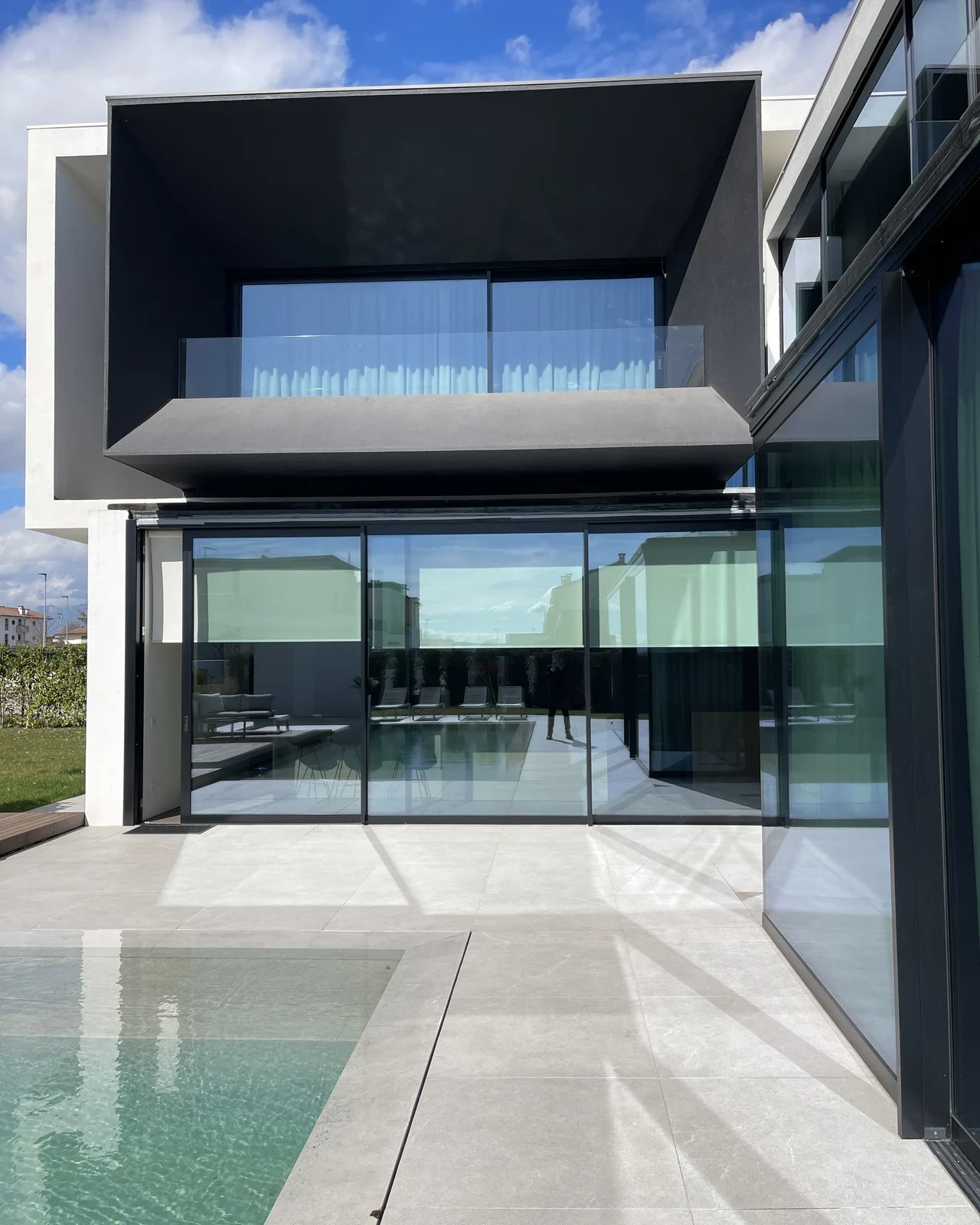
Metra glazing, Viabizzuno and OTY lighting, infinity pool: design and site direction by the studio.
The layers: what it is really made of
Resin flooring is a thin build-up, simpler than a parquet but just as dependent on the substrate. Everything under the resin shows on the surface: a crack in the screed comes back, an undulation shows in raking light, a damp area makes the finish lift.
| Layer | What it does | What to check |
|---|---|---|
| Screed | The substrate: it must be flat, dry and stable | Residual moisture, flatness, cracks, compatibility with heating |
| Primer | Bonds the resin to the substrate | Compatibility with the resin and the screed |
| Resin layer | The continuous finish | Colour, look, thickness and number of coats per the system data sheet |
| Final sealer | Gives resistance to wear, stains and slipperiness | Matt level, resistance to cleaning products, slip resistance |
The screed: where resin flooring is decided
The most delicate step is the substrate. Resin flooring does not forgive a screed that is damp, dusty, cracked or out of flat. So the curing time of the screed and the measurement of residual moisture are part of the works programme and are not shortened to meet a date. The values and methods of measurement are those given by the system data sheet and the product standards: we do not report them here because we have not verified them on the official text.
In a new villa the screed can be planned for resin, with an accurate pour and controlled shrinkage cracks; in an existing villa resin can go over an old floor only after checking its soundness and flatness. In both cases the rule is the same: resin covers, it does not solve.
Explore our projects

Schüco glazing, Minimal Cucine and Modulnova kitchen, Poliform and Baxter furniture, Occhio lighting, MAFI wood.
Invest
Before buying a luxury villa in Italy, the Dominican Republic, Zanzibar or Dubai: send us the…
Joints and cracks: a continuous surface is not infinite
Resin flooring looks like a surface without joints, but underneath it has structural joints, shrinkage joints and perimeter joints, which must be respected. If the resin is laid as a bridge over a joint, it breaks at the point where the structure moves. In the design you decide where joints will be visible and where they can be hidden in a change of material, under a threshold or in a design line.
The harder, more rigid resins, such as epoxies, follow the movement of the substrate less and carry cracks through; the more elastic ones forgive them more but scratch more easily. It is a choice made knowing the structure and the loading, and the installer should explain it before starting.
Underfloor heating and resin flooring
Resin flooring is a good partner for underfloor heating: it is thin, conducts heat well and has no joints. But it requires that the screed with the pipes has been brought up to temperature, with the gradual switching on and off provided by the supplier, before laying. Resin laid on a screed that has not settled can crack with the first heating cycles.
The operating temperature must also be coordinated: systems have a surface temperature limit given on the data sheet, and the plant is set accordingly. All of this is checked with the energy engineer and the installer before the system is decided.
Explore our projects
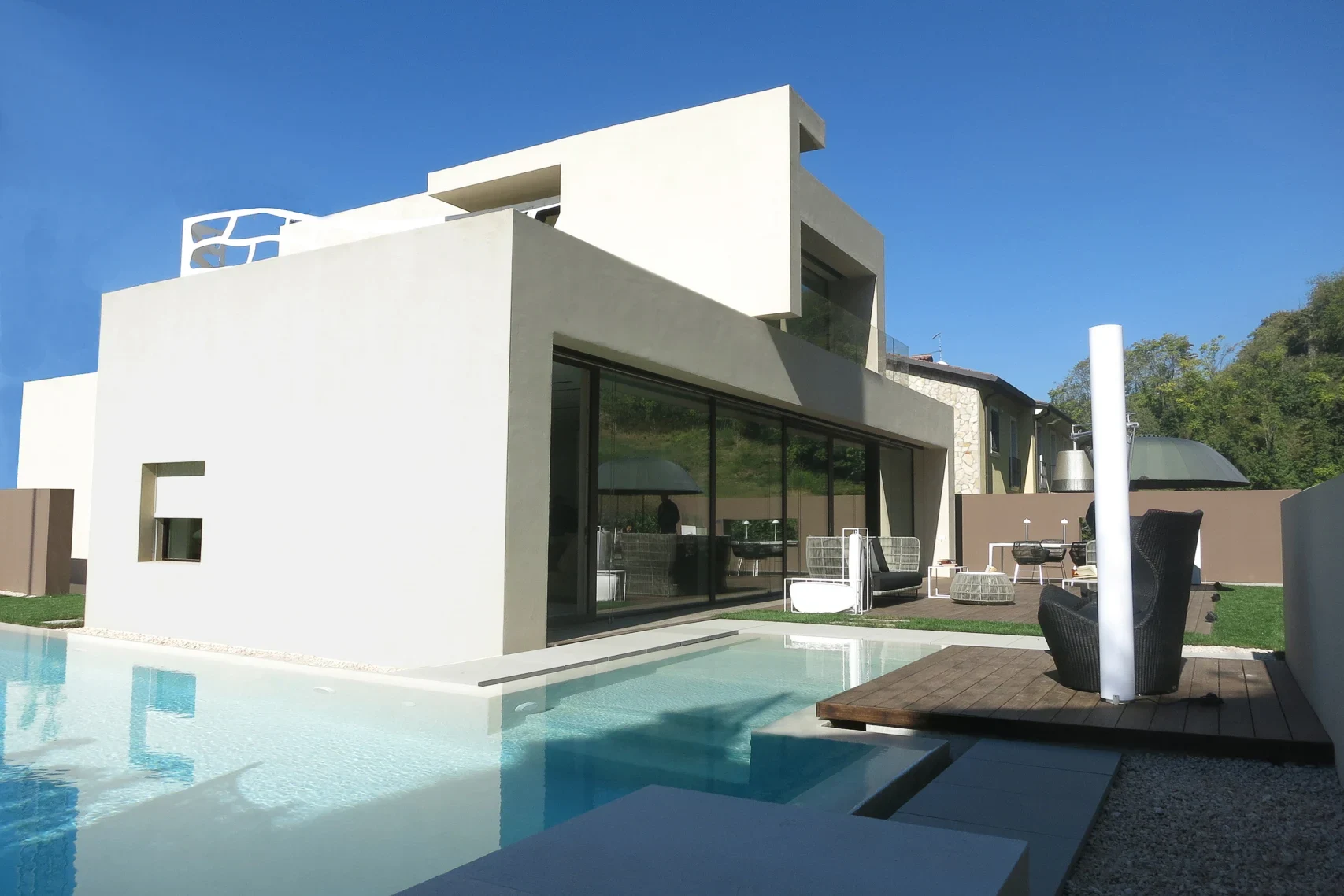
Edra sofas, Varenna kitchen, Noorth and Agape bathrooms: a studio project.
Slip resistance, bathrooms and outdoors
A continuous, smooth surface slips when wet. So the final sealer is chosen for each room: matter and rougher in the bathroom and around the walk-in shower, smoother and easy to clean in the living area. Outdoors, on a porch or terrace, the choice changes again, because rain, UV and frost are added. Ask the installer for the system data sheet with the declared slip class and check that it matches the use.
For a flush shower resin is very suitable, because there are no joints to clean; it does, however, require a precise fall to the drain and a waterproofing system under the resin, drawn together with the plumber. It is a detail to be defined in the design, not on site.
Safety on site: diisocyanates
One piece of information that rarely appears in commercial guides concerns the safety of those who lay the floor. Regulation (EU) 2020/1149, which amended Annex XVII of REACH (entry 74), regulates diisocyanates, substances found in many polyurethane resins. According to the text we read on the copy published by legislation.gov.uk, from 24 August 2023 industrial and professional use is prohibited without adequate training, unless the concentration is below 0.1% by weight, and the training must be renewed at least every five years and documented by the employer or the self-employed worker.
The regulation distinguishes three levels of training; application by roller or brush falls in the intermediate level, while spraying outside a booth falls in the advanced level. For whoever commissions the work the consequence is simple: if the chosen system contains diisocyanates, ask the installer for the product sheet and the proof of training. A firm that cannot answer is not the right one for a villa. Epoxy and cementitious resins are not the subject of this entry, but the safety data sheet remains the document to read in every case.
Ventilation must be added: during laying and curing many resins give off strong smells and vapours. In an occupied house or one with a mechanical ventilation system the site must be organised so that vapours do not enter the air circuits; openings and airing times are planned for the rooms before people return.
Architecture
Luxury interiors for villas: the 12 systems of The Villa Edit, from passive house to furniture…
Invest
Hardwood flooring explained by architects: solid or engineered, oak and other species, herringbone…
Upkeep, scratches and repairs
Resin flooring is easy to clean, but it is not indestructible. The final sealer wears in walkways, scratches from chairs and furniture show on glossy surfaces, aggressive products can dull it. Use neutral detergents and felt pads under furniture. Repairing local damage is possible but rarely invisible: the colour and reflectivity of the new resin never match the old.
For this reason it is worth asking the installer, at the end of the works, for a sample of the system and the upkeep instructions, and keeping a leftover of material from the same batch. It is an architect’s caution: resin flooring can be repaired well only if you still have the recipe.
Noise and acoustic comfort
A thin resin does not muffle footfall: the sound of steps depends on the screed and the layers below it. On the upper floors of a villa, where impact noise disturbs those below, resin flooring is paired with acoustic insulation of the slab designed in the project. Compared with hardwood flooring, resin has a colder, more reverberant acoustic quality, which is corrected with rugs, curtains and furnishings.

Invest
Walk in shower explained by architects: sizes, falls in millimetres, drains, waterproofing, 2026…
Resin flooring in our projects
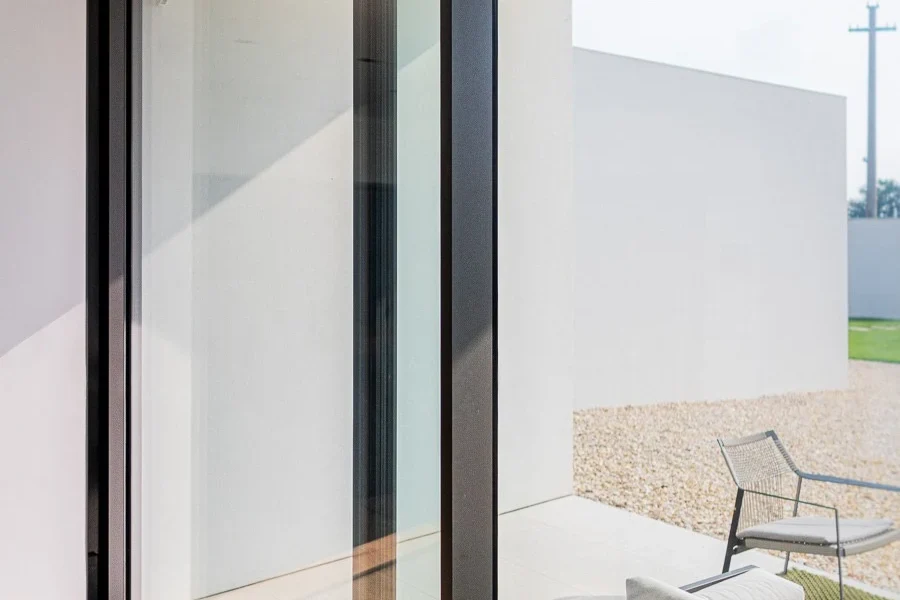
A note: the photos in this guide show interiors from the studio’s projects, and none documents resin flooring. We chose them because they show continuous surfaces, light and continuity between spaces, which is where resin flooring starts. For related topics see our guides to underfloor heating, hardwood flooring and external wall insulation.
How much does resin flooring cost
We give no figures per square metre, because they change with the type of resin, the substrate, the area, the number of coats, the joints and the preparatory works, and without a design they would be promises. The real cost of resin flooring sits in five items: screed preparation, primer and resin layers, sealer, joints and junction details, and upkeep over the years. Ask for quotes that separate them, and be wary of anyone who bundles them into a single figure.
Resin flooring: eight mistakes to avoid
- Laying resin on a screed that has not cured or is damp.
- Ignoring structural and shrinkage joints.
- Choosing the colour from a sample without seeing a trial on site.
- Using the same finish in the bathroom and in the living area.
- Laying over a heated screed that has not been brought up to temperature.
- Not asking for the installer’s training for resins with diisocyanates.
- Forgetting ventilation during laying.
- Not keeping a sample and material from the same batch for repairs.
Invest
Underfloor heating explained by architects: systems, temperatures, heat pumps, suitable floors…
Invest
External wall insulation for a villa in Italy, explained by architects: outside or inside…
Resin flooring: frequently asked questions
What is resin flooring?
It is a continuous finish made of one or more layers of synthetic resin spread over a prepared screed, with a final sealer that regulates look and resistance.
Can resin flooring go over the old floor?
Sometimes, but only after checking that the existing floor is stable, flat and well bonded. Resin does not solve the defects of the substrate: it covers them.
Is resin flooring suitable with underfloor heating?
Yes, it is thin and conducts heat well, but the screed must be brought up to temperature before laying and the operating temperature respected according to the system data sheet.
Is resin flooring slippery?
It depends on the final sealer. For bathrooms, showers and outdoors a rougher finish is chosen; ask for the slip class declared on the data sheet.
Are special precautions needed on site?
For resins with diisocyanates Regulation (EU) 2020/1149 requires, from 24 August 2023, specific training for professional users, to be renewed at least every five years. Ventilation is also needed.
Can resin flooring be repaired?
Yes, but a local repair is rarely invisible. Keep a sample and material from the same batch.
How much does resin flooring cost?
It depends on substrate preparation, type of resin, layers, joints and finish. We give no figures without a design: ask for separate quotes.
Architecture
UHNW luxury villa architecture designed and supervised by Federico Cappellina’s studio since 2002…
Designing or renovating a villa in Italy?
Send us the plan and photos of the rooms: we tell you where resin flooring makes sense, which joints to plan for and what to ask the installer. For a complete project see Signature Architecture or write to us from Contact.
Sources: Regulation (EU) 2020/1149, entry 74 of Annex XVII to REACH (diisocyanates), EUR-Lex; text read on the copy published by legislation.gov.uk. Checked on 9 November 2026. We have not verified product standards or values for substrate moisture and slip resistance, which are read on the system data sheets. Photos: projects by Federico Cappellina Architects, which do not show resin flooring.
Would you like an opinion on the project?
Send us the plan and photos of the rooms: we reply with the points to verify.
Discover the UHNW Lifestyle
The Villa Edit: materials and systems read by architects.