
ELRE
Mechanical ventilation, energy and water
Building services are invisible, yet you feel them every day: in the air, the temperature, the silence. How we design mechanical ventilation, energy and water in a villa.
Mechanical ventilation: the air you never notice
Mechanical ventilation is the system that changes life in a modern villa the most, even though nobody sees it. It brings in fresh filtered air, takes out stale air and moisture, and recovers most of the heat that would otherwise be lost. The result is a house that smells clean, with no condensation and no need to open the windows in the middle of winter.
On this page we look at the three systems that support the villa: mechanical ventilation for the air, the heat pump and solar panels for energy, treatment and recovery for water. They are designed together, because they work together.

How mechanical ventilation with heat recovery works
A compact unit, placed in a plant room, extracts air from the humid areas of the house, such as bathrooms, kitchen and laundry, and expels it outside. At the same time it draws in outside air, filters it and supplies it to the bedrooms and the living room. The two airflows pass through a heat exchanger without mixing: the outgoing air gives its heat to the incoming air.
In winter the fresh air comes in already warm; in summer, with some units, the process is reversed and helps keep the house cool. Mechanical ventilation runs continuously at low speed: a good system cannot be heard.
Why it is essential in a modern house
Today’s houses are much more airtight than in the past, and in a passive house airtightness is a requirement. Without mechanical ventilation the indoor air builds up carbon dioxide, moisture and substances released by furniture and materials. Mechanical ventilation solves the problem continuously, even when the house is empty.
Filters and air quality
Filters capture dust, pollen and part of the fine particles. Carbon dioxide and humidity sensors can be added in the bedrooms to adjust the airflow according to how many people are present. It is one of the pillars of the house designed for wellbeing that we describe in the Longevity section.
Explore The Villa Edit
The Villa Edit
The method and the 12 systems
Structure and passive house
Building system and Passivhaus
Windows and glazing
Windows, sliding doors, doors
Energy, air and water
Heat pump, ventilation, solar
Natural stone
Marble, travertine, wood
Porcelain tiles
Large slabs inside and out
Lighting
Designing the light
Luxury kitchens
Kitchen, appliances, compost
Bathroom, spa and wellness
Master bathroom, sauna, recovery
Furniture
Living, bedrooms, walk-in closets
Pools and gardens
Outdoor, landscape, robots
Home automation and security
One system for the whole house
Art and objects
Collections and signature pieces
Private service
Private consultation
Would you like to plan the building services of your villa?
Contact usDesigning mechanical ventilation in a villa
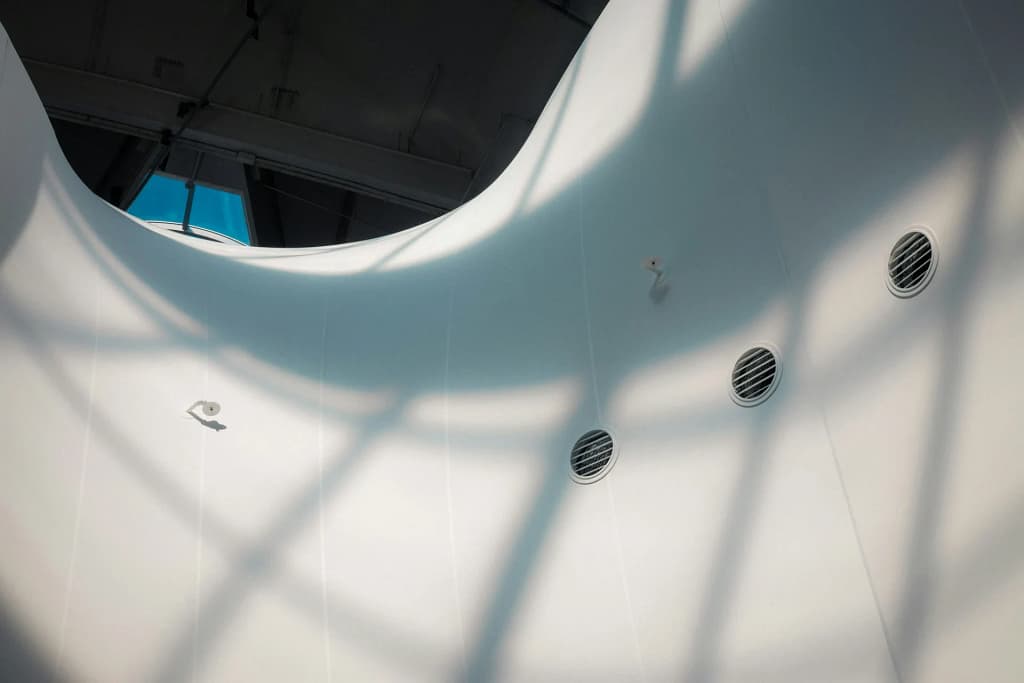
Mechanical ventilation must be designed together with the architecture. It needs a plant room, routes for the ducts in the ceilings or screeds, discreet vents in every room and outdoor air intakes away from exhausts and fumes. In a minimalist villa vents and grilles become thin slots in the ceiling or walls.
Sizing is done room by room: bedrooms receive fresh air, bathrooms and kitchen extract it. An undersized system is not enough; an oversized one is noisy. This is why mechanical ventilation is calculated, not chosen from a catalogue.
Energy: heat pump, solar panels and storage
In the villas we design the goal is an all-electric house, with no gas, powered largely by the sun. The heat pump produces heating in winter, cooling in summer and domestic hot water; solar panels produce the energy; batteries store it for the evening and the night.
Heat pump
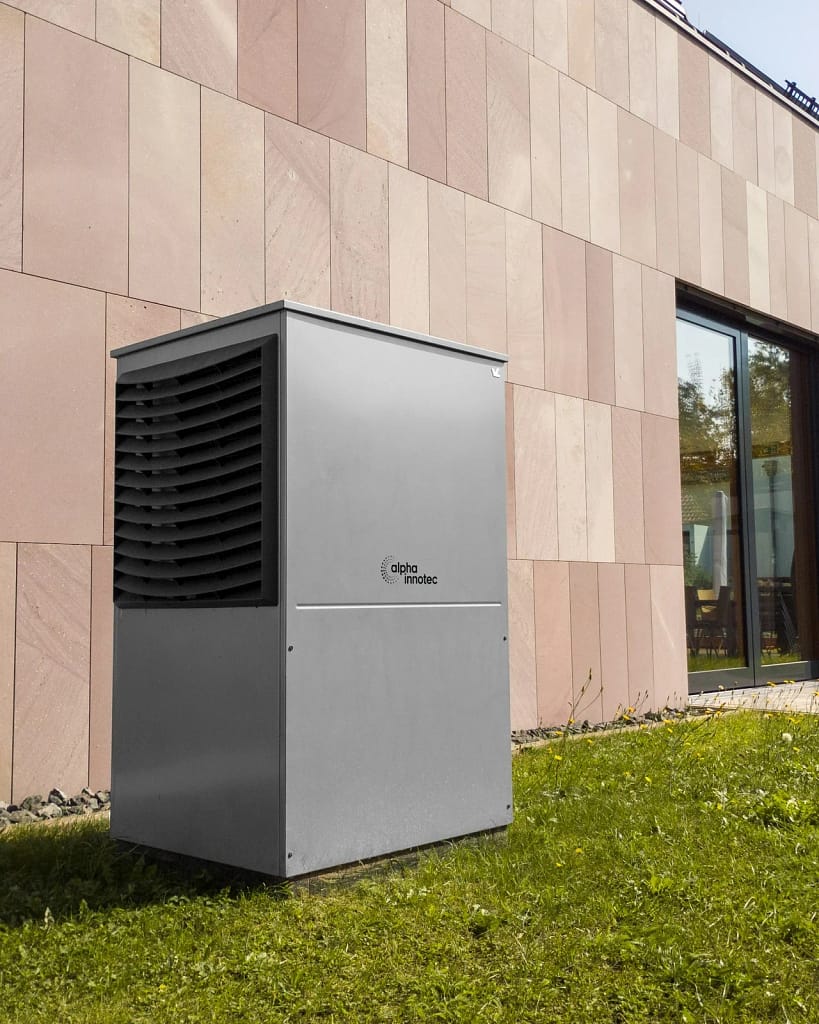
A heat pump takes energy from the outside air, the ground or water and brings it into the house. In a villa with a highly insulated envelope the required output is small, and mechanical ventilation can distribute part of the heating and cooling. The choice between underfloor heating, fan coils or air depends on the desired comfort and the climate.
The Villa Edit

Explore our projects

Schüco glazing, Minimal Cucine and Modulnova kitchen, Poliform and Baxter furniture, Occhio lighting, MAFI wood.
Solar panels and batteries
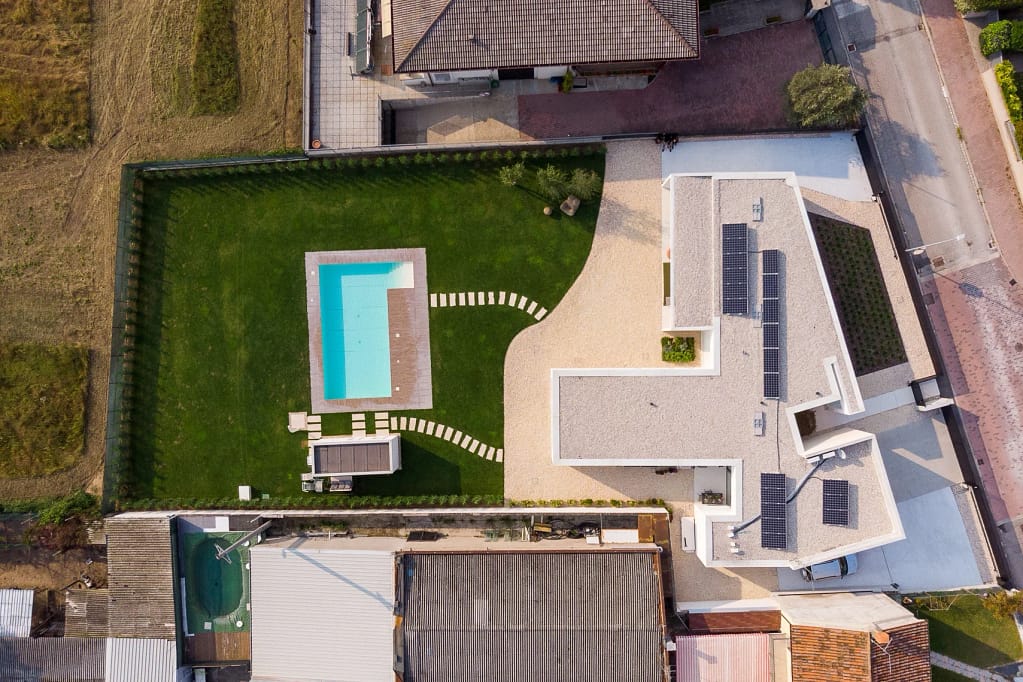
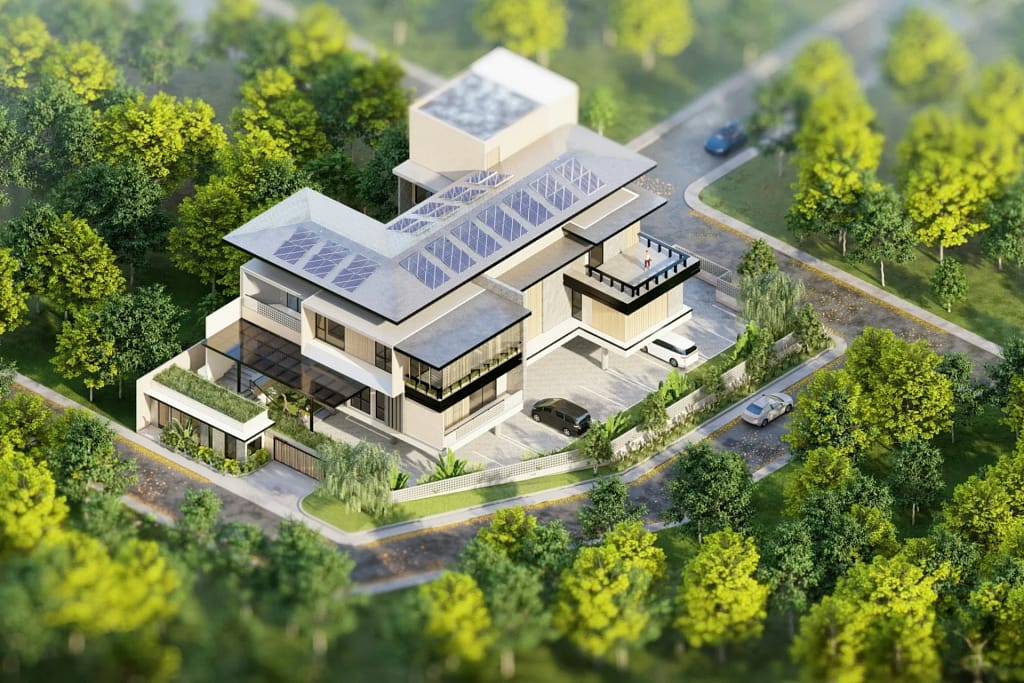
Solar panels on the roof, or integrated into pergolas, produce energy for the house, the heat pump and the electric car charger. A storage system keeps the daytime surplus. With smart load management the villa uses energy when there is most of it: the pool filters at midday, the car charges during the day.

The Villa Edit

Water: quality, recovery and control
Water is the villa’s third system. A treatment system at the inlet improves the water quality of the whole house and protects taps and boilers from limescale; a filter in the kitchen provides good drinking water. A tank collects rainwater from the roof to irrigate the garden. Leak sensors in bathrooms and plant rooms shut off the water in case of a fault.
The studio's standard for energy and air
Mechanical ventilation with heat recovery in all living areas; carbon dioxide and humidity sensors in the bedrooms; a heat pump sized on the energy calculation; no gas connection; solar panels with storage sized on real consumption; rainwater recovery for the garden; a plant room accessible for maintenance.
Three levels: Essential, Signature, Icon
Essential: centralised mechanical ventilation, air-to-water heat pump, solar panels. Signature: mechanical ventilation with sensors in the bedrooms and high-efficiency filters, battery storage, smart load management, water treatment. Icon: continuous air quality monitoring, geothermal heat pump, extended energy autonomy, rainwater recovery for garden and services.
The Villa Edit

The companies we consider
Mechanical ventilation: Zehnder
Zehnder, a Swiss group, is one of the references for mechanical ventilation with heat recovery and for air distribution systems in high-performance houses.
Heat pumps: Viessmann, NIBE, Daikin, Mitsubishi Electric
For heat pumps we assess Viessmann, NIBE, Daikin and Mitsubishi Electric, choosing according to the required output, noise level, local service and integration with the mechanical ventilation.
Solar and water
For inverters and storage we look at manufacturers with direct service in Italy, such as Fronius and SMA. For water treatment, at BWT and Culligan.
Independent selection: the brands mentioned are chosen for quality, performance and service. No brand pays to appear on this page and the links lead to the official websites. Prices, availability and terms should be checked with the manufacturer or with the studio during the design phase.
Heating: floor, air or ceiling
In a well-insulated villa little heat is needed, and the way it is distributed becomes a choice of comfort. Underfloor heating warms evenly and silently; ceiling systems also work well for cooling; fan coils are quick and allow dehumidification. In a passive house part of the heating and cooling can also go through the mechanical ventilation, with a simpler system.
Cooling and humidity
In summer discomfort often comes from humidity more than temperature. A dehumidifier integrated with the mechanical ventilation removes excess moisture and lets you feel comfortable at less low temperatures, using less energy. In hot, humid climates, such as the Caribbean or East Africa, dehumidification is the most important part of the system.
Domestic hot water
The heat pump also produces hot water, kept in a cylinder sized on the number of bathrooms and real use. In a villa with a spa, bathtubs and experience showers the demand peaks are high: the design must provide adequate storage and short pipe runs so as not to waste water while waiting for it to heat up. Smart recirculation, controlled by the home automation, brings hot water to the taps only when needed.
Explore our projects

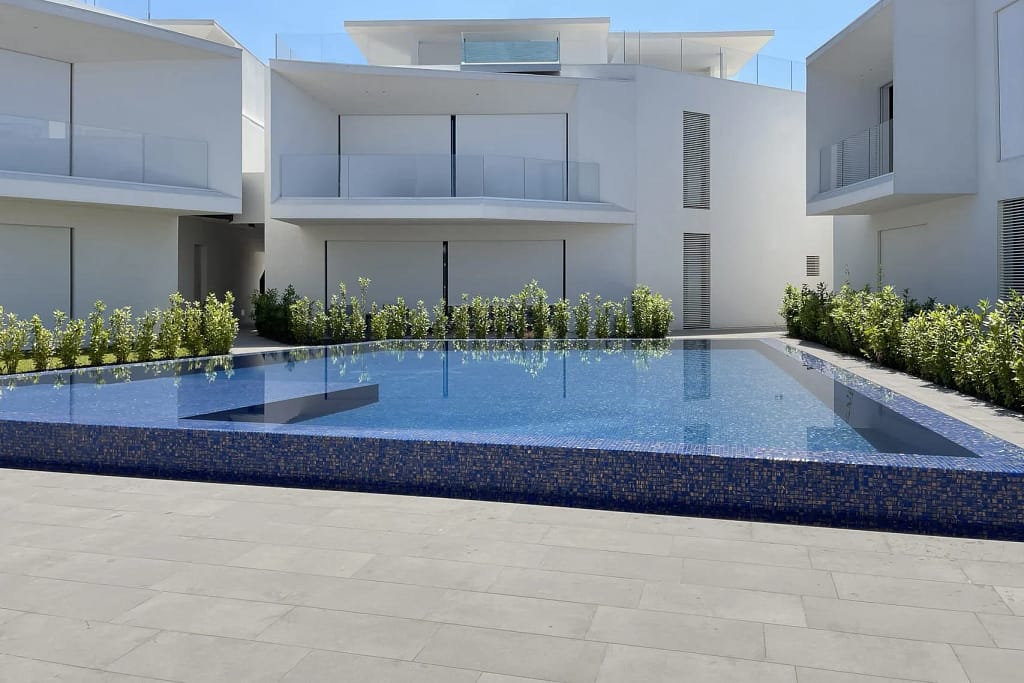
Metra glazing, Viabizzuno and OTY lighting, infinity pool: designed and supervised by the studio.
Electric cars and load management
Charging an electric car is now part of a villa’s installation. A wallbox connected to the solar panels charges the car with the sun’s energy; a load management system prevents the induction hob, heat pump, pool and car from exceeding the available power together. The same logic applies to the sauna and spa, which draw a lot of energy for a short time.
Monitoring to improve
A modern villa can measure production, consumption, temperature, humidity and air quality in real time. The data serve two purposes: noticing a fault immediately, for example a pump using more than usual, and improving the settings over time. With mechanical ventilation, carbon dioxide monitoring tells you whether the bedrooms receive enough fresh air during the night.
The plant room
All this lives in a well-designed plant room: large enough to work in, ventilated, reachable without crossing the house, with space to replace a unit. It is a room you never see, but it makes the difference between a villa that is easy to run and one full of problems. The mechanical ventilation plant room must allow the filters to be changed in a few minutes.
The Villa Edit

Centralised or decentralised mechanical ventilation
There are two main families of mechanical ventilation. Centralised systems use a single unit and a network of ducts reaching every room: the most efficient and quietest solution for a new villa. Decentralised systems use small wall units, room by room, each with its own heat recovery: useful in renovations, when there is no space for ducts.
In the villas we design from scratch we almost always prefer centralised mechanical ventilation, with the unit in the plant room and ducts concealed in the ceilings or screed. The vents become thin slots, coordinated with the lighting and the lines of the architecture.
Heat recovery and humidity recovery
Some recovery units also transfer part of the moisture from the outgoing air to the incoming air. In winter they stop the indoor air from becoming too dry; in summer, in humid climates, they help keep it dry. The choice between the two types depends on the climate and the number of people living in the villa.
The Villa Edit

Air and wellbeing: what to measure
Air quality is measured with a few parameters. Carbon dioxide tells you whether a room is well ventilated: in bedrooms, at night, it rises quickly if the air is not renewed. Relative humidity should stay in an intermediate band, neither too dry nor too humid. Fine particles depend on the outside air and the filters; volatile organic compounds on materials and cleaning products.
A sensor system connected to the mechanical ventilation adjusts the airflow automatically and shows the data on your phone. We make no health promises: we offer measured, controlled air, the same condition we describe in our pages on sleep and wellbeing.
Energy: how much solar power is needed
Solar capacity is calculated on the villa’s real consumption: heat pump, mechanical ventilation, kitchen, pool, spa, electric car. In a well-insulated house heating weighs little and the rest counts more. The available roof area is often the real limit; solar pergolas, carport canopies and facade-integrated panels widen the options.
Storage is sized to cover the evening and night, not to make the house fully autonomous, which would require very large batteries. For those who want continuity in a power cut, a system can be planned that islands the villa from the grid and powers the essential loads.
Explore our projects

Edra sofas, Varenna kitchen, Noorth and Agape bathrooms: a project by the studio.
The Villa Edit

Water: from the well to the garden
In some areas the villa can use a well for irrigation or, with the right treatment and permits, for other uses. The rainwater tank is sized on the roof area and on the garden’s needs. A drip irrigation system, controlled by the home automation and a rain sensor, uses water only when needed. We cover this on the page about the garden and pool.
Quiet building services
Silence is one of the most appreciated qualities of a villa and building services can spoil it. The outdoor units of heat pumps should be placed away from bedrooms and relaxation areas, on anti-vibration mounts, screened if necessary. The mechanical ventilation unit must sit in a room with walls that insulate against noise, and the ducts need silencers before the bedrooms.
In the design we set a maximum noise level in the bedrooms and check it against the manufacturers’ data. It is a detail clients almost never ask for, but notice every night.
Mechanical ventilation and the kitchen
The kitchen hood must be coordinated with the mechanical ventilation: in an airtight house a very powerful extractor hood pulls air out of the house. The solutions are recirculating hoods with effective filters, or extractor hoods with a dedicated air inlet operated together with the hood. We cover this on the page about luxury kitchens.
The Villa Edit

The Villa Edit

The most common mistakes
Adding mechanical ventilation once the design is finished, when there is no longer space for ducts and unit. Putting the unit somewhere inaccessible, so the filters never get changed. Choosing an oversized heat pump that keeps switching on and off. Forgetting the noise of the outdoor unit near the bedrooms or the pool.
The Villa Edit

The Villa Edit

How it fits with the rest of the house
Mechanical ventilation depends on the airtightness of the envelope and on the windows; the home automation regulates airflows and temperatures; the solar panels also power the pool and the induction kitchen. A good design makes everything work together, instead of adding one system after another.
Maintenance
Mechanical ventilation requires the filters to be replaced, usually once or twice a year, and periodic cleaning of ducts and vents. The heat pump and solar panels should be checked by a technician every year. The maintenance dates go into the villa’s file, with automatic reminders.
Frequently asked questions about mechanical ventilation
Is mechanical ventilation noisy?
A well-designed and well-installed system cannot be heard in the bedrooms. Noise almost always comes from undersized ducts or a unit in the wrong position.
Can mechanical ventilation be installed in an existing villa?
Yes, with centralised systems if there is space for ducts, or with decentralised units room by room.
Does mechanical ventilation replace air conditioning?
No, but it helps: it renews and filters the air; cooling remains the job of the heat pump.
How much energy does it use?
Very little: the fans run at low speed and heat recovery saves far more energy than they consume.
Designing building services with the studio
The studio of Federico Cappellina coordinates architecture and building services from the first sketch: where the mechanical ventilation ducts run, where the plant room goes, where panels and outdoor units are placed without spoiling the architecture.
The Villa Edit

Planning a villa?
The studio coordinates architecture, materials, building services and furniture in a single project.
Discover the whole UHNW lifestyle
Energy, air and water are the third of the twelve systems of The Villa Edit, the technical heart of the house.