
ELRE
Porcelain tiles in large slabs
The material that carries continuity from the kitchen to the pool, from the bathroom to the facade. How to choose the right porcelain tiles for a luxury villa.
Porcelain tiles: the surface of continuity
Porcelain tiles are a ceramic material pressed and fired at very high temperatures, dense and almost impermeable. They resist stains, scratches, frost, sun and chemicals, and today they are made in large slabs with the look of stone, marble, concrete, resin or wood. For a contemporary villa porcelain is the surface of continuity: the same material from the living room to the terrace, from the kitchen to the pool edge.
Alongside natural stone, porcelain tiles are a valuable design tool. Where stone would be too delicate, too heavy or too costly to maintain, porcelain offers consistent performance and huge surfaces without visible joints.
What porcelain tiles really are
Porcelain is made from a mix of clays, feldspars and sands, pressed and fired at very high temperatures. Firing makes the material vitrified and compact: water absorption is extremely low, which is why it resists frost and stains. Standards classify ceramic tiles by water absorption; porcelain tiles belong to the group with the lowest absorption.
There are two main families. Through-body porcelain has the same colour throughout its thickness, so a deep scratch is barely noticeable. Glazed porcelain has a decorated surface that reproduces marble and stone with great realism. Large, thin slabs are a category of their own, also suitable for cladding furniture and worktops.
Large slabs: the revolution of recent years
Until a few years ago a large tile measured one metre. Today large porcelain slabs exceed three metres in length, with thicknesses ranging from a few millimetres for wall cladding to two centimetres for outdoor use. A bathroom wall can become a single slab; a floor of a hundred square metres can have a few very thin joints.
Large slabs change the way we design: formats are chosen together with room dimensions, cuts are drawn like those of stone, joints are aligned with doors, windows and furniture. It is precision work that makes the difference between an ordinary floor and an architectural surface.
Explore The Villa Edit
The Villa Edit
The method and the 12 systems
Structure and passive house
Building system and Passivhaus
Windows and glazing
Windows, sliding doors, doors
Energy, air and water
Heat pump, ventilation, solar
Natural stone
Marble, travertine, wood
Porcelain tiles
Large slabs inside and out
Lighting
Designing the light
Luxury kitchens
Kitchen, appliances, compost
Bathroom, spa and wellness
Master bathroom, sauna, recovery
Furniture
Living, bedrooms, walk-in closets
Pools and gardens
Outdoor, landscape, robots
Home automation and security
One system for the whole house
Art and objects
Collections and signature pieces
Private service
Private consultation
Would you like help choosing the surfaces of your villa?
Contact usWhere to use porcelain tiles in a villa
Interior floors
For interior floors, stone-effect or concrete-effect porcelain tiles are the most frequent choice in minimalist villas: uniform, hard-wearing, easy to clean, suitable for underfloor heating. With large slabs the floor becomes a continuous surface that amplifies the space.
Bathroom and spa cladding
In bathrooms porcelain allows walls without joints, walk-in showers in the same material as floor and walls, niches and shelves cut from the slabs. In the wellness area it resists the humidity and heat of the sauna and steam room. We cover this on the page about the luxury bathroom.
Kitchen worktops
Thin porcelain slabs are used as worktops and as cladding for islands and doors: they resist the heat of pans, scratches and stains from wine and lemon, which would ruin a marble. Edges and thicknesses are worked on CNC machines. We cover this on the page about luxury kitchens.
Outdoors, terraces and pool edges
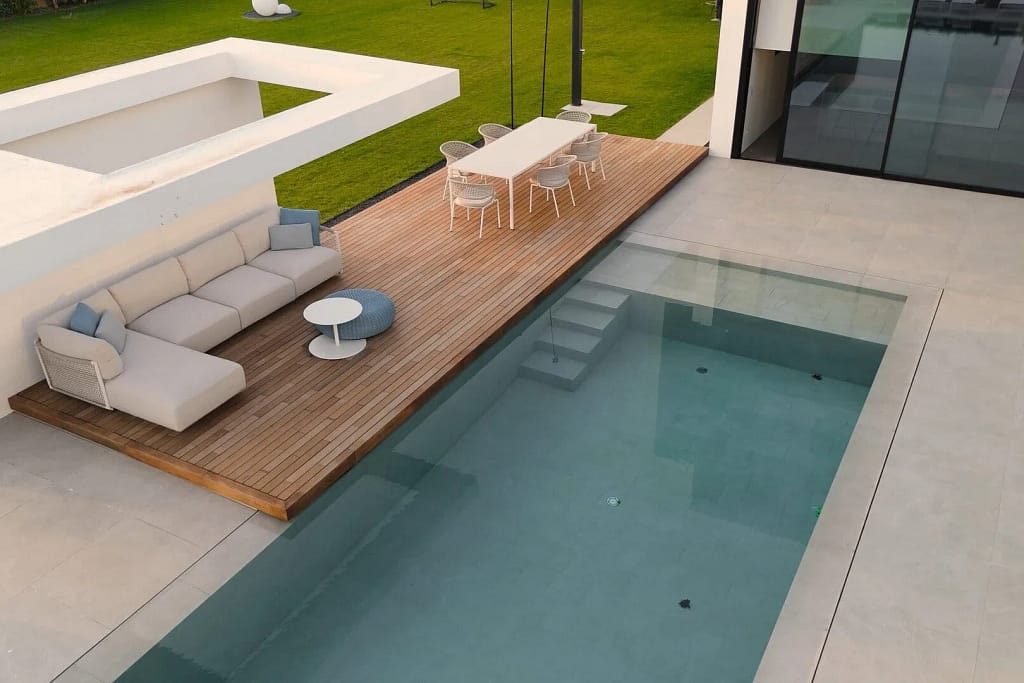
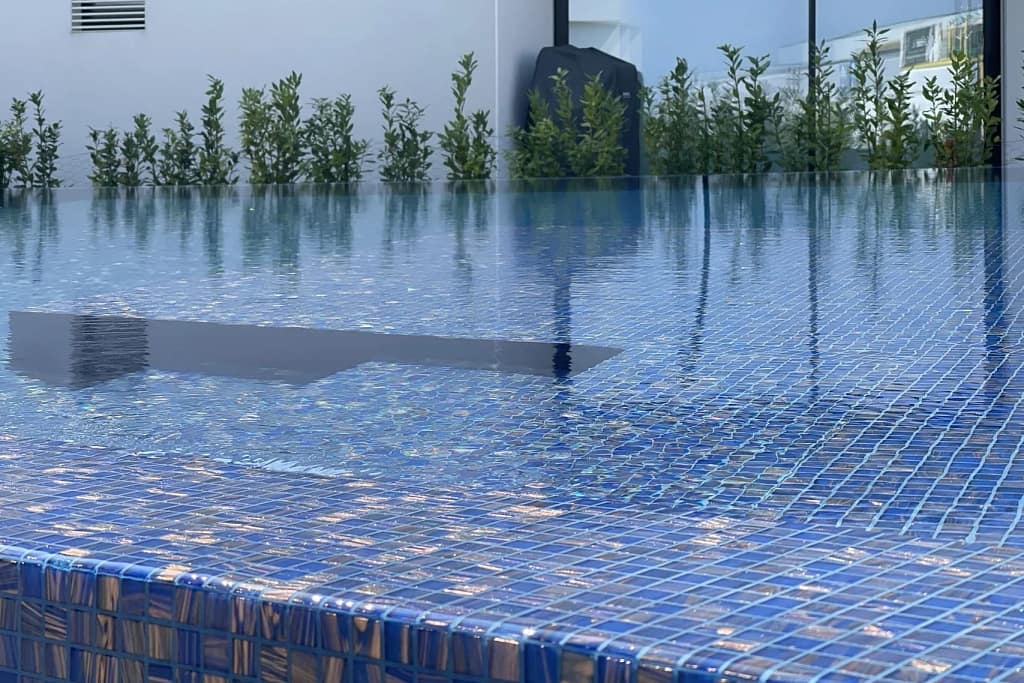
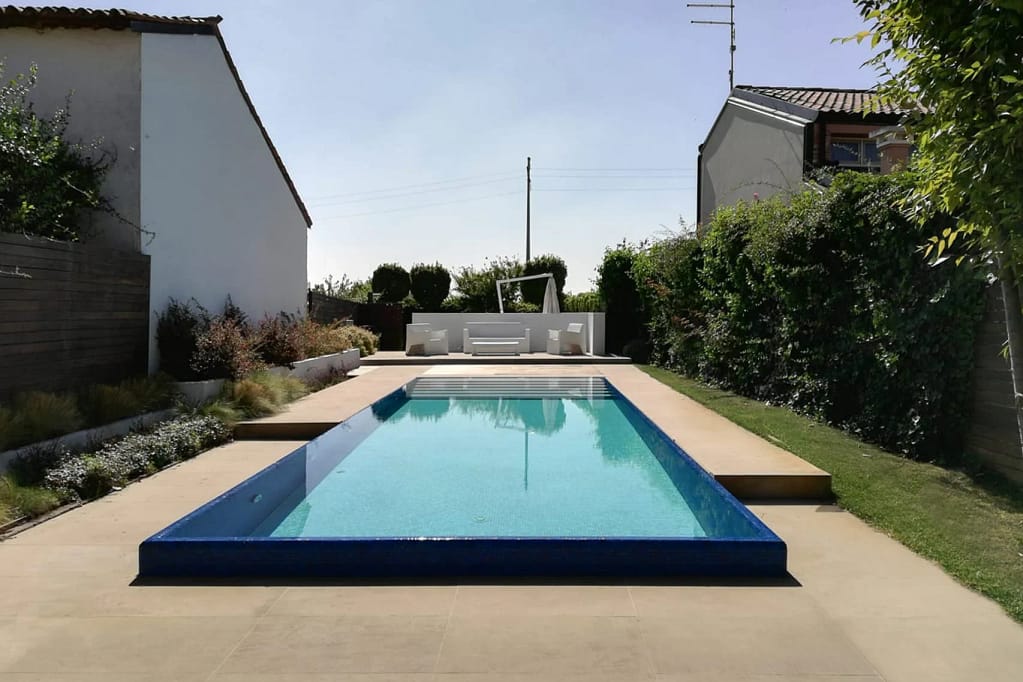
Outdoors, thicker porcelain is used, laid on adhesive or on adjustable pedestals that create a raised, draining floor. Textured finishes provide slip resistance; light colours stay cool in the sun. Around the pool there are special edge pieces, with a rounded return and a matching overflow grille, as we describe on the page about luxury pools.
The Villa Edit

Explore our projects

Schüco glazing, Minimal Cucine and Modulnova kitchen, Poliform and Baxter furniture, Occhio lighting, MAFI wood.
Ventilated facades
Porcelain is also a facade material: slabs hooked onto a metal frame, set away from the wall, with an air gap that protects the insulation and carries heat away in summer. It is a durable solution that needs no maintenance and works well with the envelope of a passive house.


The Villa Edit

Slip resistance: the classes to know
The safety of floors is measured with laboratory tests. For areas walked on with shoes a scale from R9 to R13 is used: the higher the number, the greater the grip. For barefoot areas, such as pool edges, showers and spas, a different scale is used, with classes A, B and C. In the studio’s specifications we state the required class for each room.
Inside the house, porcelain tiles that are too slip-resistant are harder to clean: this is why we use different finishes of the same product, smoother inside and more textured outside, keeping the same colour.
Installation: where the result is decided
Large porcelain slabs require specialist installers and dedicated equipment: vacuum lifting frames, high-performance adhesives spread both on the substrate and on the back of the slab, levelling systems to avoid lips between one slab and the next. The substrate must be perfectly flat and cured.
Joints shrink to a few millimetres but do not disappear: they are needed to absorb expansion. The screed movement joints are also drawn in the design and must be respected during installation. An installation error on a large slab is not easily corrected: this is why we entrust it only to teams with documented experience.
The Villa Edit

Porcelain tiles or natural stone?
It is not a competition. Natural stone is unique, can be re-honed and ages with a patina; porcelain is consistent, hard-wearing and worry-free. In the studio’s projects we use them together: natural stone where emotion counts, such as a carved basin or the living room wall; porcelain tiles where resistance and continuity count, such as the kitchen, outdoor areas and service bathrooms.
A useful rule: if a surface will be treated roughly every day or must stay identical for years, porcelain tiles are often the wiser choice. If it must express the material and age with the house, natural stone has no rivals.
The studio's standard for porcelain tiles
A technical data sheet with water absorption, frost resistance and slip class for every room; samples seen as whole slabs and in natural light; a layout drawing with cuts and joints; qualified installers for large slabs; a stock of material from the same batch kept at the villa for possible replacements.
Explore our projects

Metra glazing, Viabizzuno and OTY lighting, infinity pool: designed and supervised by the studio.
Three levels: Essential, Signature, Icon
Essential: quality porcelain tiles in medium formats, stone or concrete effect, the same material inside and out. Signature: large slabs on floors and walls, coordinated kitchen worktops and bathrooms, raised outdoor flooring. Icon: large-format slabs with veining continuous across consecutive slabs, ventilated facades, furniture clad in the same material.
The porcelain tile brands we consider
Italy is the world leader in porcelain tiles, with the ceramic district of Sassuolo and Fiorano Modenese. These are the manufacturers we start from, chosen for quality, aesthetic research and technical documentation.
Florim and Atlas Concorde
Florim and Atlas Concorde are two large groups in the Emilian district with very wide collections of porcelain in large slabs, stone and marble effects, and solutions for outdoor areas and facades.
Laminam
Laminam specialises in large-format, thin ceramic slabs, used for floors, walls, facades and kitchen and furniture surfaces.
Mutina and Mirage
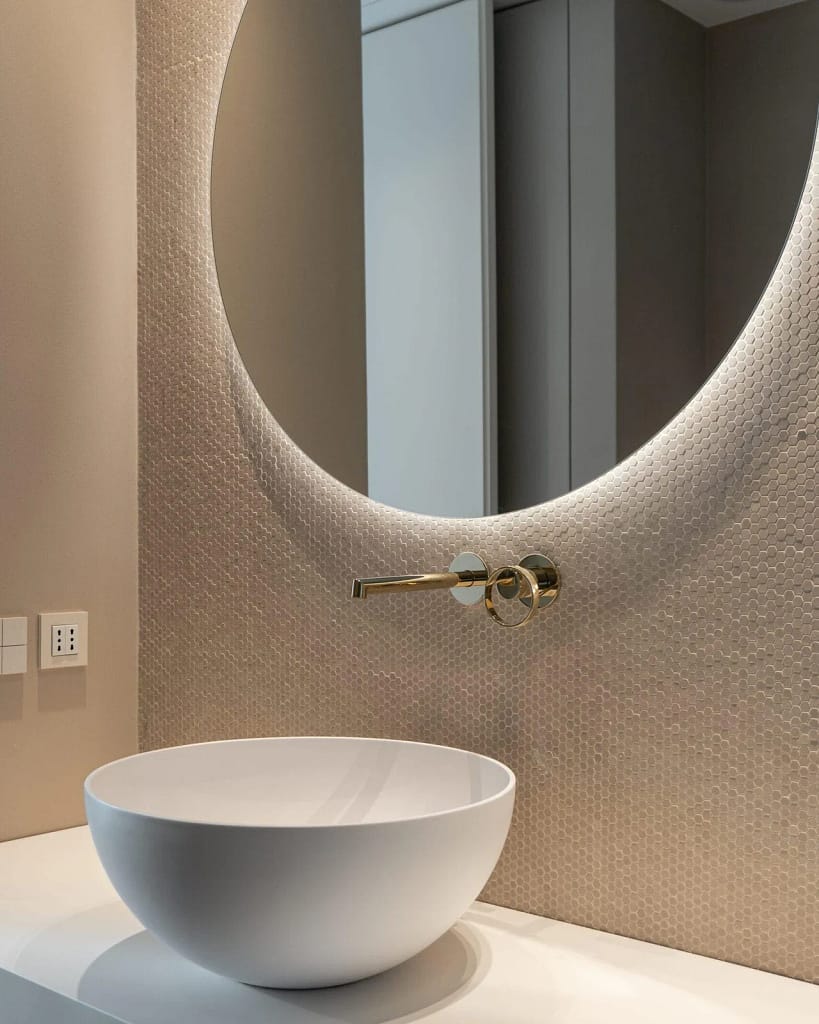
Mutina works with internationally renowned designers on ceramic surfaces with a strong material character. Mirage makes porcelain for interiors and exteriors in a wide range of thicknesses.
In one of the studio’s villas, architect Federico Cappellina clad the girls’ bathroom with Mutina’s hexagonal mosaic, paired with brass taps and a round backlit mirror.
Independent selection: the brands mentioned are chosen for quality, performance and service. No brand pays to appear on this page and the links lead to the official websites. Prices, availability and terms should be checked with the manufacturer or with the studio during the design phase.
Porcelain tile effects
Stone effect
The most used effect in villas: it reproduces limestones, slates, quartzites and local stones with credible colour variations. Stone-effect porcelain tiles are perfect for those who want the atmosphere of stone with the resistance of ceramics, especially outdoors and in circulation areas.
Marble effect
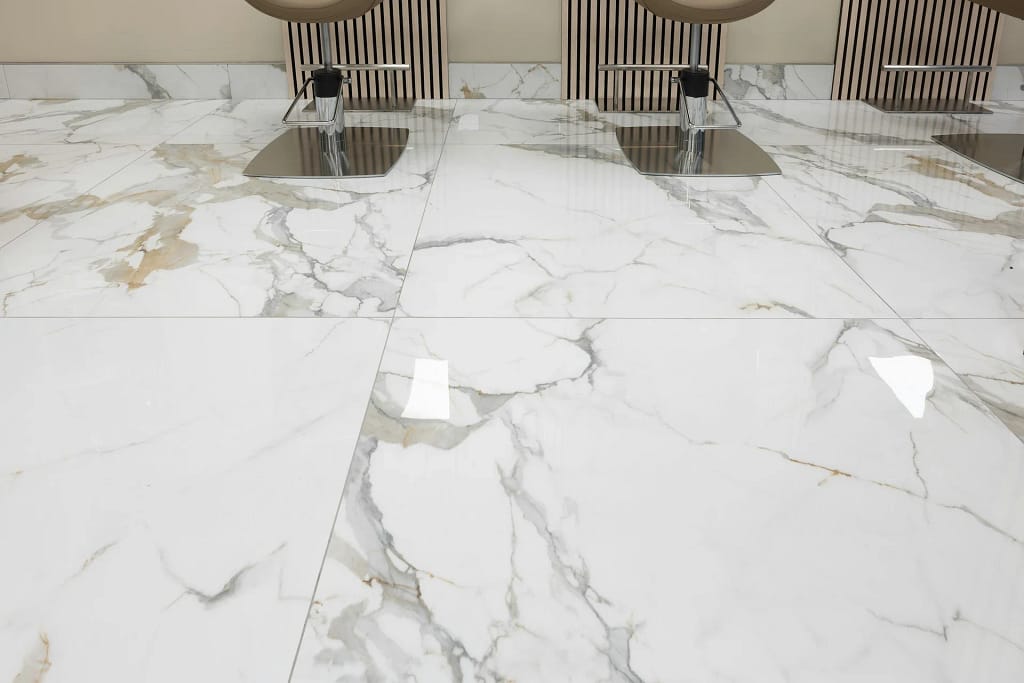
Large marble-effect slabs reproduce the veining of Calacatta, Statuario or dark marbles. Some collections allow book-matched installation, with mirrored veining across consecutive slabs. They suit bathrooms, living room walls and worktops: they give the image of marble without its delicacy.
The Villa Edit

Concrete and resin effect
Uniform, matt surfaces with slight variations, which suit minimalist architecture. Concrete-effect porcelain gives the continuity of resin without its fragility: it does not scratch, does not yellow and does not fear water.
In SD Home, the studio’s villa in Soave, the staircase is finished in resin: a continuous surface without joints that binds treads, risers and landings into a single light volume.
Wood effect
Long planks that reproduce oak and other woods, useful where real wood would suffer: bathrooms, verandas, pool edges, terraces. In a villa we prefer real wood indoors and use wood-effect porcelain tiles only where they are truly needed.
Thicknesses, formats and transport
The thickness of porcelain changes its use: thin slabs for walls, furniture and renovations over existing floors; standard thicknesses for floors; greater thicknesses for outdoor areas and raised floors. Formats are chosen on the room dimensions, to reduce cuts and waste.
Large slabs arrive on A-frames, are handled with dedicated equipment and must be able to get into the house: doors, stairs and lifts must be checked before ordering. On site they need flat storage surfaces and protection from knocks, because the edges are the most delicate part.

The Villa Edit

Porcelain tiles and sustainability
Many Italian porcelain manufacturers publish environmental product declarations, use recycled raw materials and recover water and heat in their processes. Long life is the first environmental advantage: a floor that lasts decades without being replaced weighs far less than one that has to be redone. In our specifications we ask for the environmental certifications available for each product.
Porcelain in the kitchen: worktops and cladding
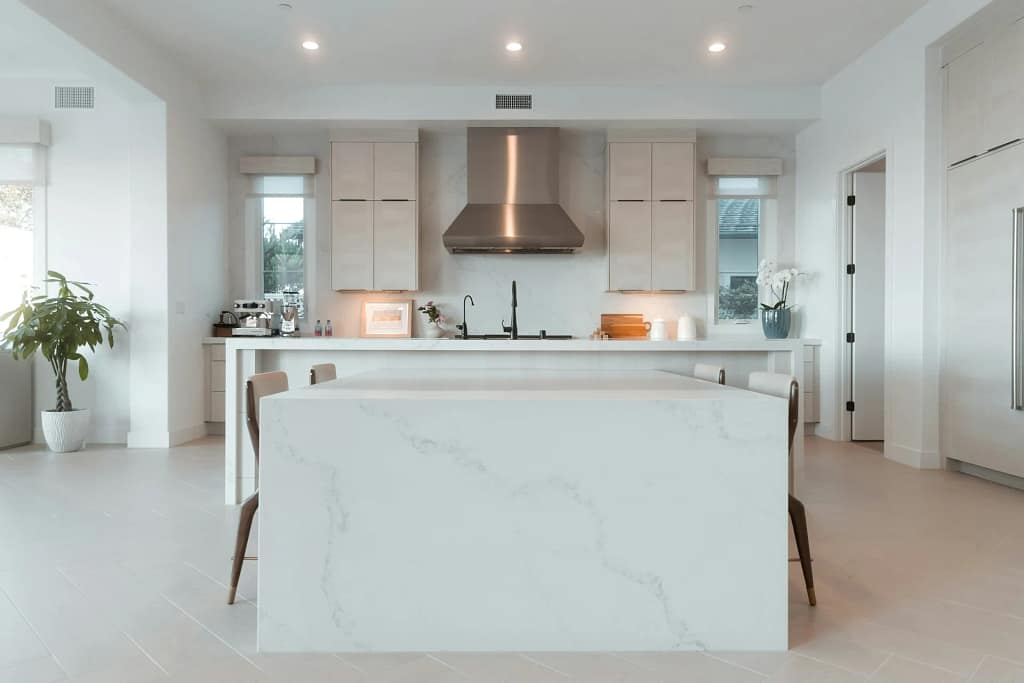
In the kitchen thin porcelain slabs clad worktops, islands, splashbacks and even doors. The advantage is continuity: the same material from the floor to the worktop, with mitred edges that suggest a single block. Holes for sinks and induction hobs are cut in the workshop, on CNC machines, to measurements taken on site.
Porcelain resists heat, but it is better not to put scorching pans directly on the worktop; it resists scratches, but knives are dulled by cutting on it. These are simple rules we explain in the villa manual handed to the client.
Porcelain tiles in the studio's projects
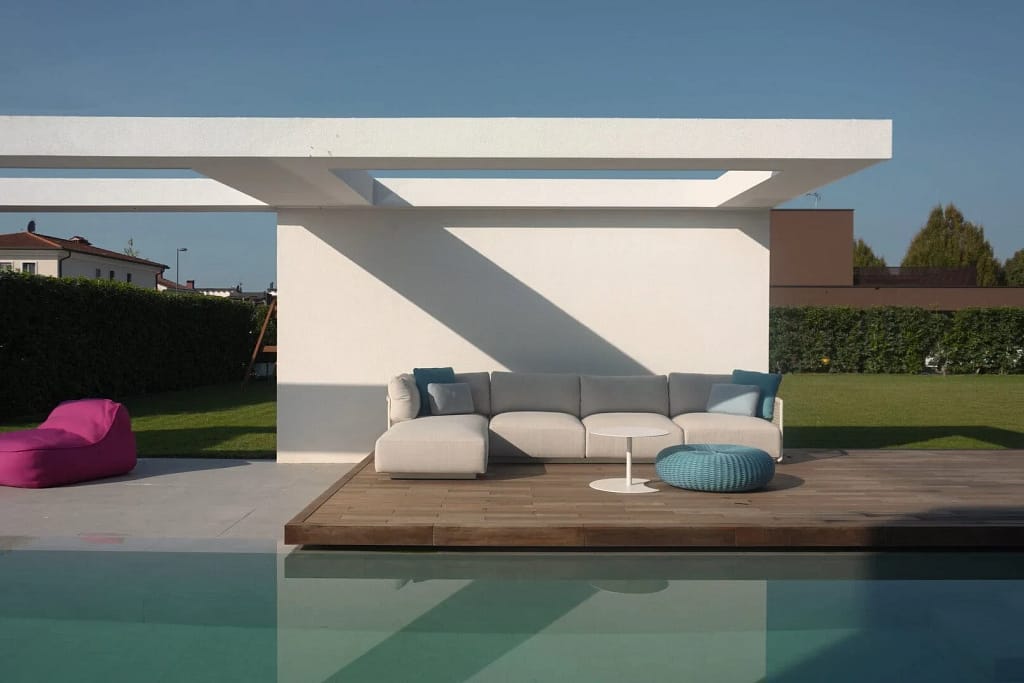
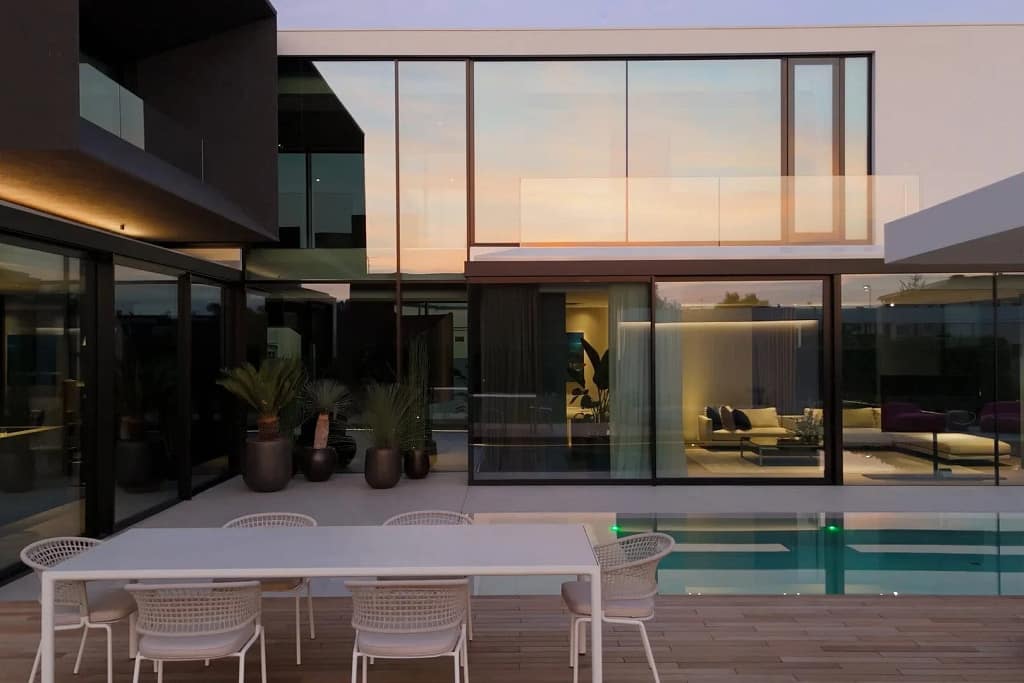
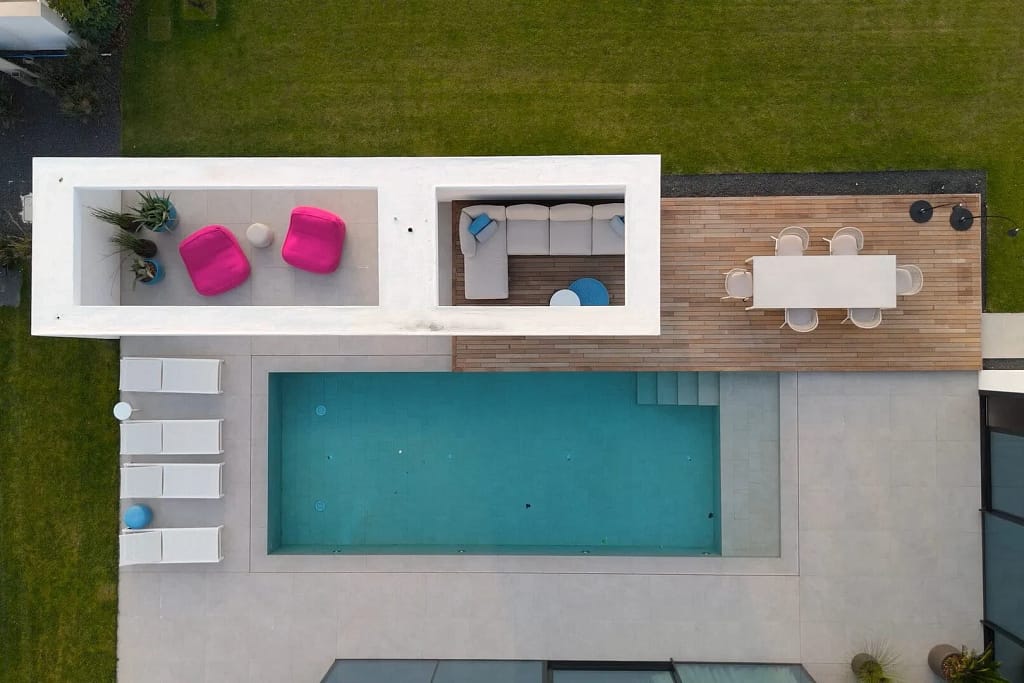
In the studio’s projects large porcelain slabs often tie inside and outside together: the same tone from the living room to the terrace, all the way to the pool edge, with two different finishes for safety and cleaning. The images on this page come from these projects, including the pools and sun decks of AV Home and of the Lugana Bay complex on Lake Garda.
The Villa Edit

Explore our projects

Three villas with pools under construction, PURA Sistemi windows: a project by the studio.
The most common mistakes
Choosing porcelain tiles from a photo or a small sample: large slabs must be seen whole, because the pattern repeats. Using the same finish indoors and on the pool edge, with the risk of slipping. Laying large slabs on screeds that are not cured or not flat. Forgetting expansion joints outdoors. Not ordering a stock from the same batch.
The Villa Edit

The Villa Edit

Maintenance
Porcelain tiles need very little maintenance: water and neutral detergents for daily cleaning, a specific cleaner after installation to remove grout residue. Porcelain is not treated like natural stone. Textured outdoor finishes are cleaned with a brush or a floor scrubber; polished slabs need soft cloths to avoid streaks.
How they fit with the rest of the house
Porcelain tiles link many of the villa’s systems: the kitchen floor continues onto the terrace and reaches the pool; the bathroom walls interact with the light; the ventilated facade is part of the envelope. Choices are made for the whole house, with a single materials board.
Frequently asked questions about porcelain tiles
Do porcelain tiles work with underfloor heating?
Yes, they conduct heat well and are stable. They are laid with suitable adhesives and respecting the screed joints.
Can porcelain be used as a kitchen worktop?
Yes, thin large-format slabs are used as worktops: they resist heat, scratches and stains. Edges and holes are worked in the workshop.
How large is a large slab?
It depends on the manufacturer: the largest formats exceed three metres in length. The real limits are transport, access to the site and installation.
Outdoor porcelain tiles: what thickness?
For terraces and paths greater thicknesses are used, usually two centimetres, on adhesive or on pedestals for a raised floor.
Choosing porcelain tiles with the studio
The studio of Federico Cappellina designs floors as part of the architecture: formats, cuts, joints, continuity between inside and out. We prepare the specification with the required performance and follow the installation with qualified contractors.
The Villa Edit

Planning a villa?
The studio coordinates architecture, materials, building services and furniture in a single project.
Discover the whole UHNW lifestyle
Porcelain tiles are the fifth of the twelve systems of The Villa Edit, the companion of natural stone.