
ELRE
Designer lighting: designing the light
Light does not only illuminate the house: it shapes the way we perceive it. How we design the lighting of a villa, inside and out.
Designer lighting: designing the light, not the lamps
Designer lighting in a villa is not a list of lamps. It is a design that decides how the house looks by day and by night, how shadows move, which materials are enhanced and how the atmosphere changes between a dinner with guests and an evening alone. Good designer lighting is almost unnoticeable: what you notice is the house.
In this guide we explain how the studio designs the light of a villa: natural light, the layers of artificial light, scenes, outdoor lighting, and the designer lighting brands we consider for each role.
It starts with natural light
The first lighting design is the architecture itself. Orientation, size and position of windows, skylights, patios and overhangs decide the daylight, the most beautiful and the most important for wellbeing. An east-facing bedroom receives the morning sun; a south-facing living room has full light in winter and must be protected in summer; a skylight brings light into the central areas of the house.
Artificial designer lighting completes natural light, it does not replace it. This is why lighting design starts with the architecture and continues with the windows and shading.
Explore The Villa Edit
The Villa Edit
The method and the 12 systems
Structure and passive house
Building system and Passivhaus
Windows and glazing
Windows, sliding doors, doors
Energy, air and water
Heat pump, ventilation, solar
Natural stone
Marble, travertine, wood
Porcelain tiles
Large slabs inside and out
Lighting
Designing the light
Luxury kitchens
Kitchen, appliances, compost
Bathroom, spa and wellness
Master bathroom, sauna, recovery
Furniture
Living, bedrooms, walk-in closets
Pools and gardens
Outdoor, landscape, robots
Home automation and security
One system for the whole house
Art and objects
Collections and signature pieces
The four layers of artificial light
1. General light
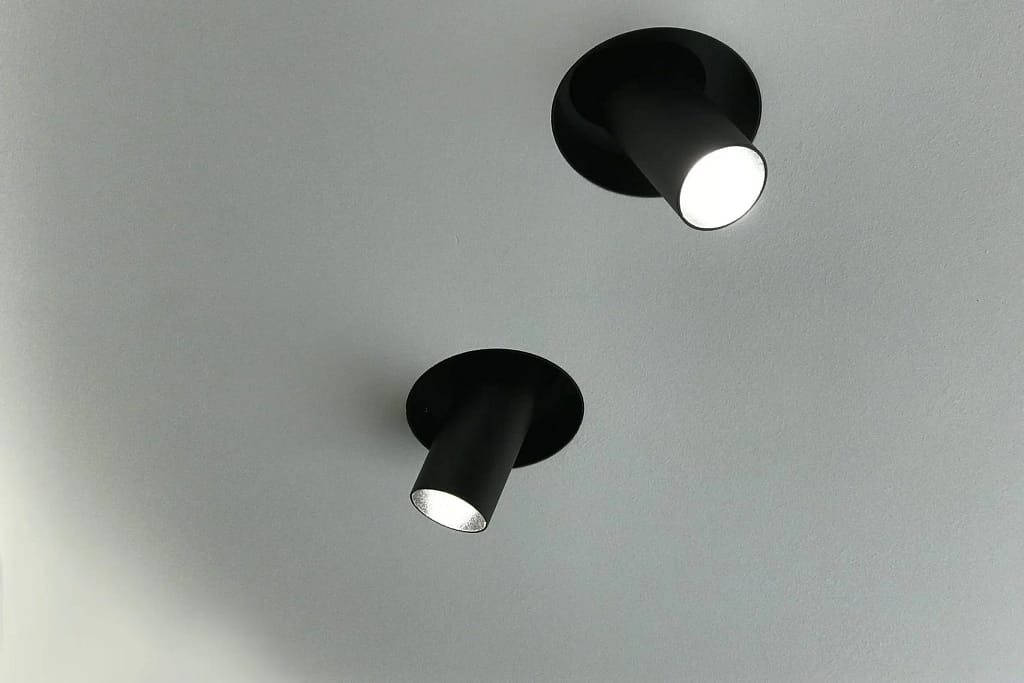
It is the light that lets you move around and see. In a minimalist villa it is often concealed: slots in the ceiling, recessed profiles, light reflected off walls and ceilings. It must be even and glare-free.
2. Task light
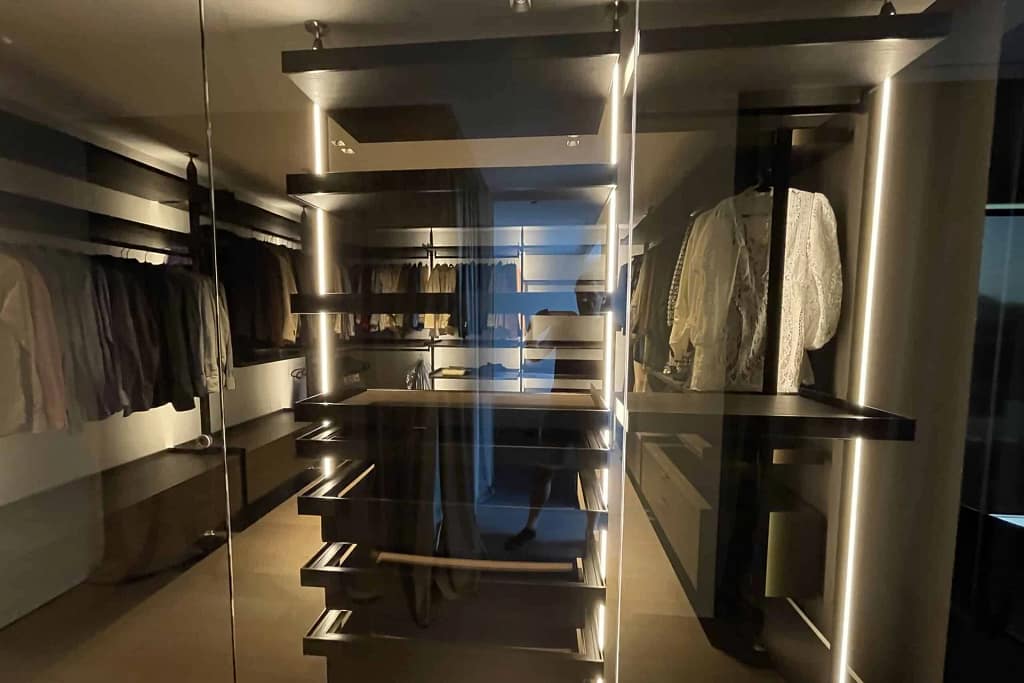
It is the light for doing things: the kitchen worktop, the bathroom mirror, the desk, the walk-in closet. It must be precise, well aimed, with high colour rendering to see food and fabrics as they really are.
3. Accent light
It is the light that tells a story: a painting, a stone wall, a sculpture, a bookcase. Adjustable spotlights and grazing light enhance materials and objects, as we describe on the page about art and design objects.
4. Decorative light
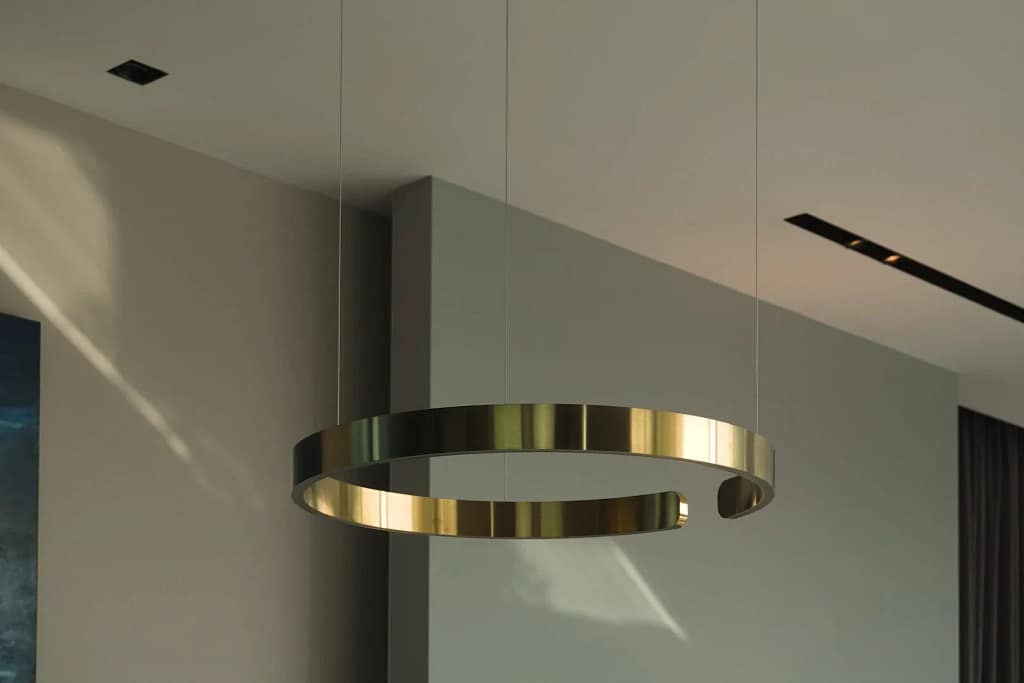
This is designer lighting in its best-known sense: the pendant above the table, the floor lamp next to the sofa, the wall light that becomes a sculpture. They are few pieces, chosen the way you choose a work of art, and switched on mainly in the evening.
Colour temperature and colour rendering
Colour temperature is measured in kelvin. Warm light, around 2700 or 3000 K, is welcoming and suited to the evening and bedrooms; more neutral light is needed where you work. In villas we prefer warm light in living and sleeping areas and neutral light only in plant and service rooms.
Colour rendering indicates how faithfully a light shows colours. For a house with stone, wood and works of art we ask for sources with very high colour rendering: materials appear as they are, without colour casts. It is one of the details that distinguish designer lighting from simple lighting.
The Villa Edit

Explore our projects

Metra glazing, Viabizzuno and OTY lighting, infinity pool: designed and supervised by the studio.
Glare and visual comfort
Badly aimed light tires the eyes. In designer lighting we avoid sources visible from the sofa, the bed and the table; we use spotlights with shielded optics and deep recesses; we prefer light reflected off surfaces to light shining into the eyes. In bedrooms the light must be low and warm in the evening, to accompany rest.
Scenes and control
The same room lives different moments: morning, work, dinner, cinema, night. With a control system each moment has its scene: one button switches on, dims and switches off dozens of light points together. Dimming is essential in a designer lighting project; professional systems also allow the colour temperature to change over the course of the day.
Scenes are integrated with the home automation: lights come on at sunset, switch off when the house is empty, simulate presence while you travel and connect to the alarm. Wall controls stay simple, with a few clear buttons.


Outdoor lighting
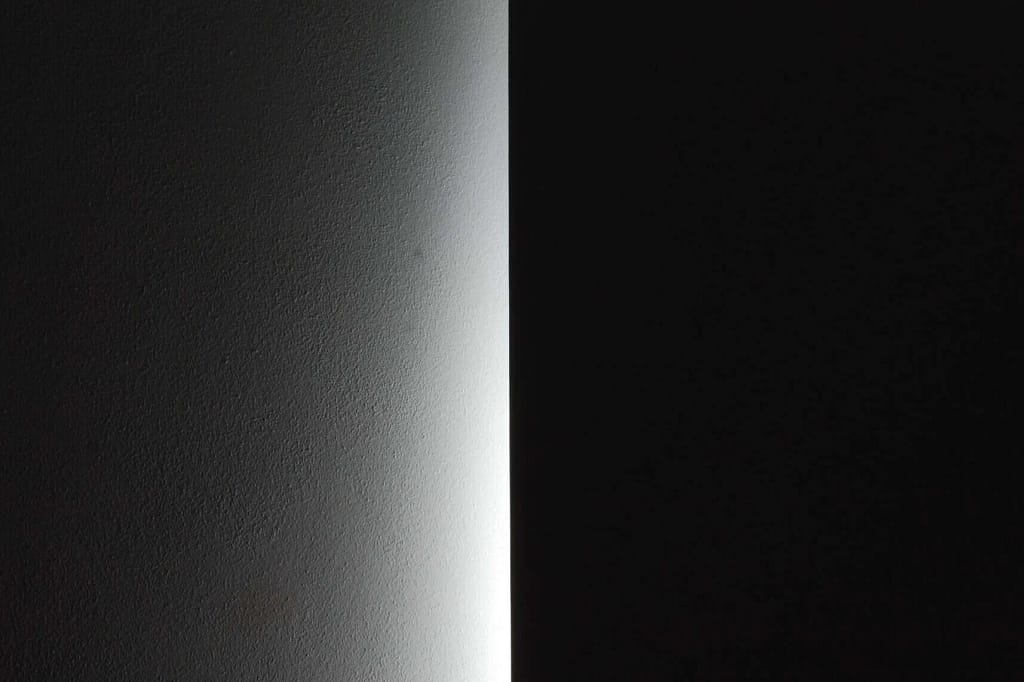
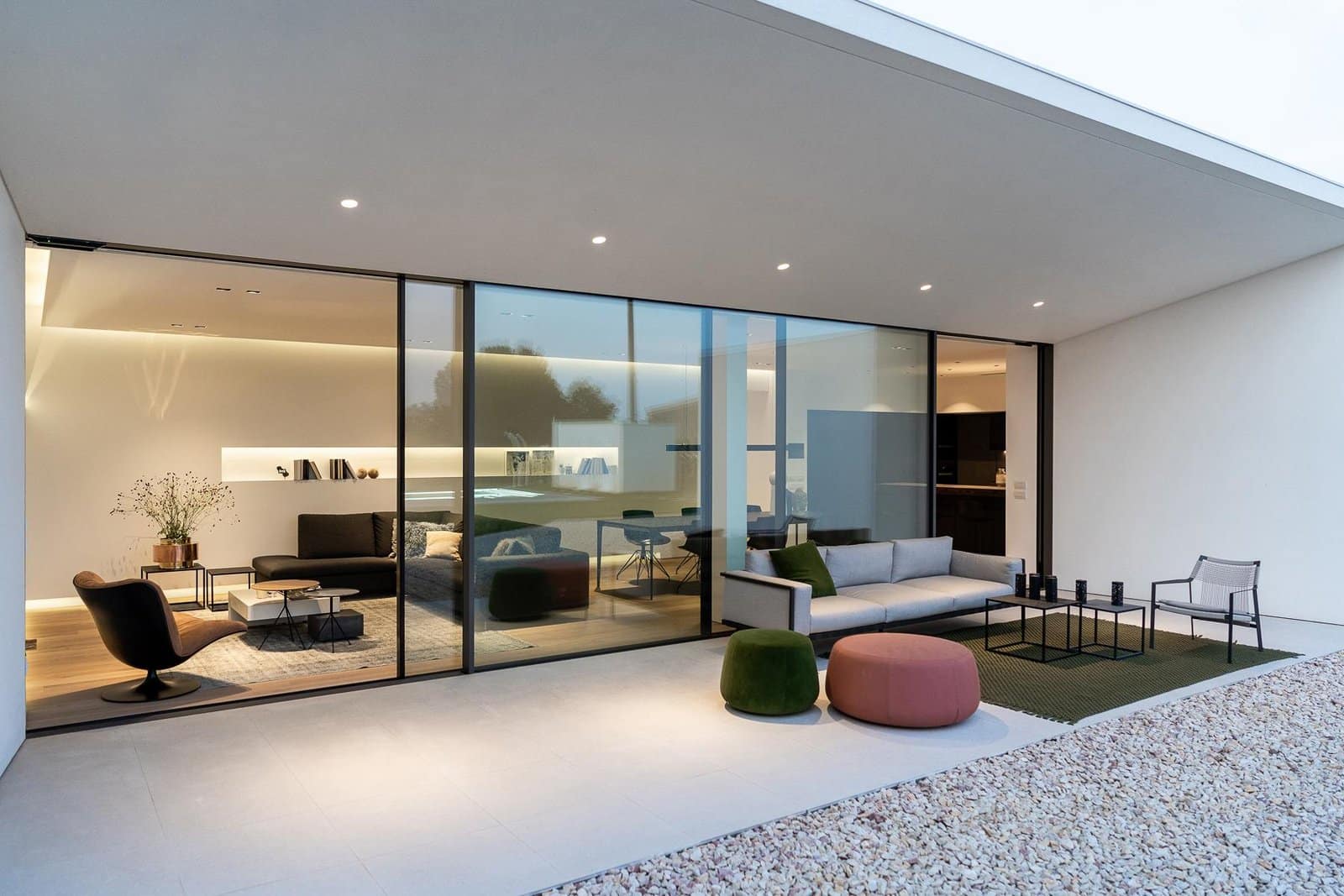
At night the garden becomes a second home. Outdoor designer lighting reveals trees, walls and volumes with warm grazing light, marks paths with low light points and lights the pool from within. Less is more: a few well-placed sources, pointing downwards, respect the darkness of the landscape and do not disturb the neighbours.
Outdoor fittings must have an ingress protection rating suited to water and dust, corrosion-resistant materials and, near the sea, specific finishes. We also cover this on the page about pools and gardens.
Dynamic light and the rhythm of the day
Some systems can vary intensity and colour temperature during the day, with cooler, brighter light in the morning and warmer, lower light in the evening. We see it as a comfort tool, consistent with the way we experience natural light; we make no health promises. Sleep and the bedroom are covered in our wellbeing section.
The studio's standard
A lighting design with plans of light points and scenes; warm, high colour rendering sources in living areas; no glaring sources from seating and resting positions; dimming in all living and sleeping areas; limited, shielded, downward-facing outdoor light; maintenance sheets and spare parts for every fitting.
The Villa Edit

Explore our projects

Schüco glazing, Minimal Cucine and Modulnova kitchen, Poliform and Baxter furniture, Occhio lighting, MAFI wood.
Three levels: Essential, Signature, Icon
Essential: recessed general light, dimming, a few quality decorative lamps. Signature: a complete lighting design, scenes, accent light on materials and works, decorative designer lighting chosen with the architect. Icon: dynamic light, signature or bespoke pieces, scenographic lighting of the landscape.
The designer lighting brands we consider
Italy has a unique tradition in designer lighting. Alongside Italian brands we consider a few European manufacturers specialising in architectural light.
Flos and Artemide
Flos, founded in 1962, and Artemide, founded in 1960, are two icons of Italian designer lighting, with decorative lamps that have become classics and lines dedicated to architectural light.
Davide Groppi and Viabizzuno
Davide Groppi, from Piacenza, designs essential, poetic lamps, perfect for minimalist architecture. Viabizzuno, from Bologna, works on architectural lighting design with an approach very close to that of architects.
In AV Home, the studio’s villa in Dueville, the ground-floor lighting is by Viabizzuno; the bedroom floor uses fittings by OTY Light, an Italian architectural lighting company.

Foscarini, Louis Poulsen, Vibia
Foscarini, from Venice, is known for decorative lamps with sculptural forms. Louis Poulsen, from Denmark, carries the tradition of soft, glare-free light of Nordic design. Vibia, from Barcelona, offers decorative and architectural lighting systems.
Delta Light, Occhio, iGuzzini
For technical and architectural light we look at Delta Light, from Belgium, Occhio, from Munich, and iGuzzini, a company from the Marche specialising in light for architecture.
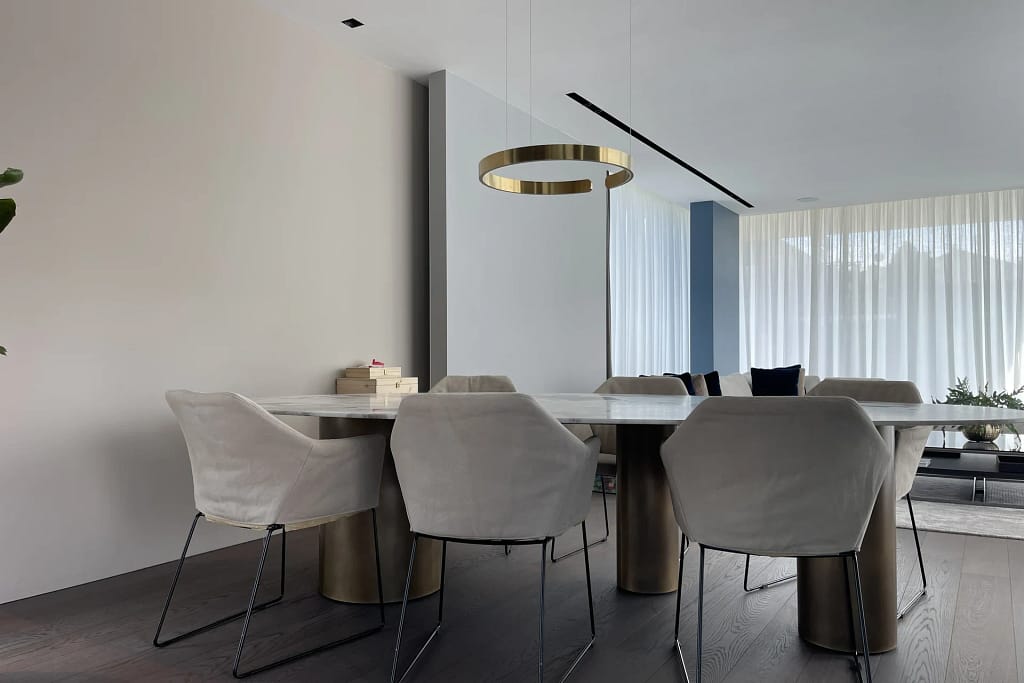
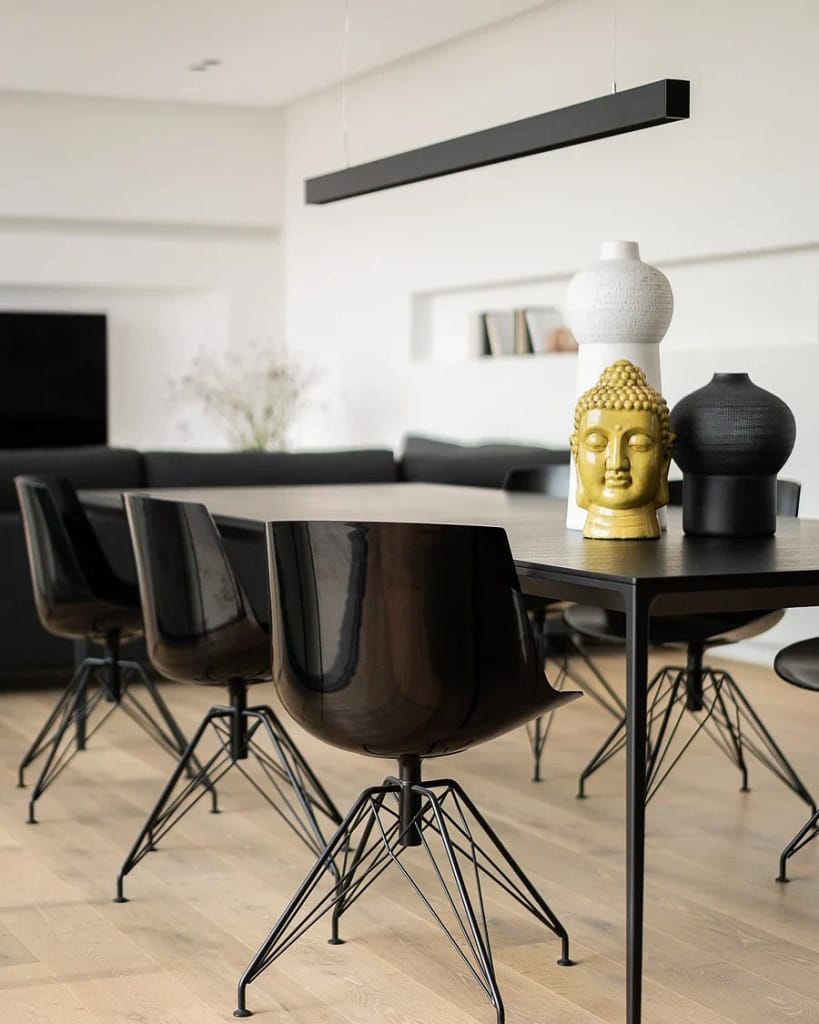
In MD Home, the studio’s villa in Verona, the chandelier above the dining table is by Occhio: a thin line of light that follows the length of the table.
Independent selection: the brands mentioned are chosen for quality, performance and service. No brand pays to appear on this page and the links lead to the official websites. Prices, availability and terms should be checked with the manufacturer or with the studio during the design phase.
Room by room
Entrance
The entrance is the first impression: warm light, a decorative lamp or a slot of light leading towards the living room, automatic switching on when the door opens. At night a low light lets you find your way without switching everything on.
Living and dining
In the living room designer lighting works on several layers: indirect light along the walls, accents on paintings and surfaces, floor and table lamps next to the seating. Above the dining table a scenographic pendant, dimmable, becomes the centre of the room in the evening.
Kitchen
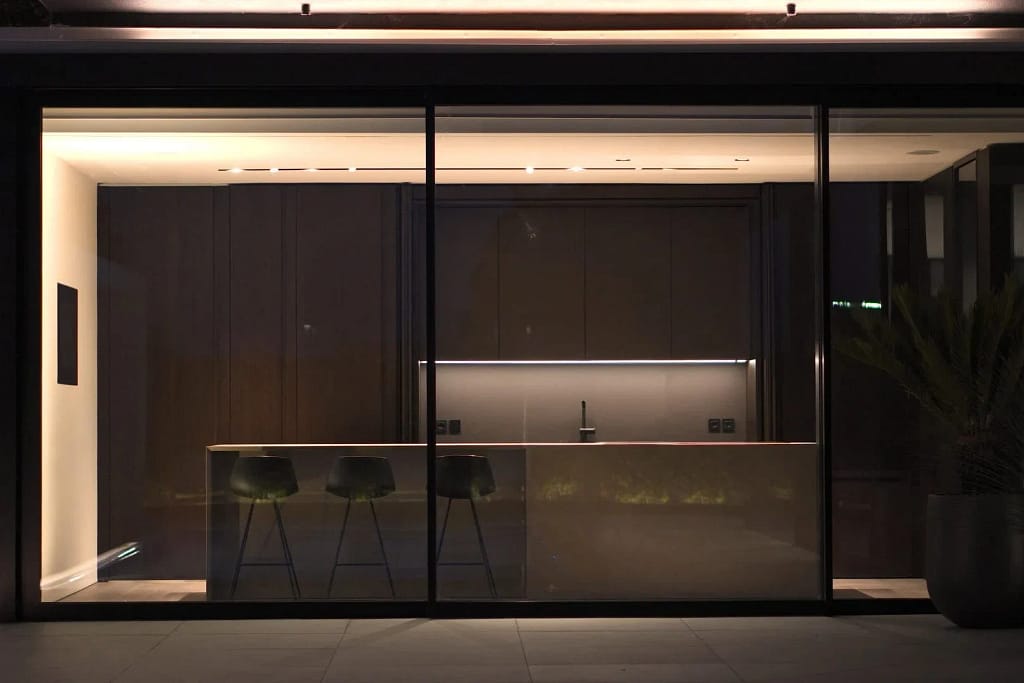
In the kitchen you need precise task light on the worktops, without shadows cast by the person working: profiles under the wall units or well-aimed spotlights above the island. A softer light accompanies the moments when the kitchen becomes part of the living room.
Bedrooms
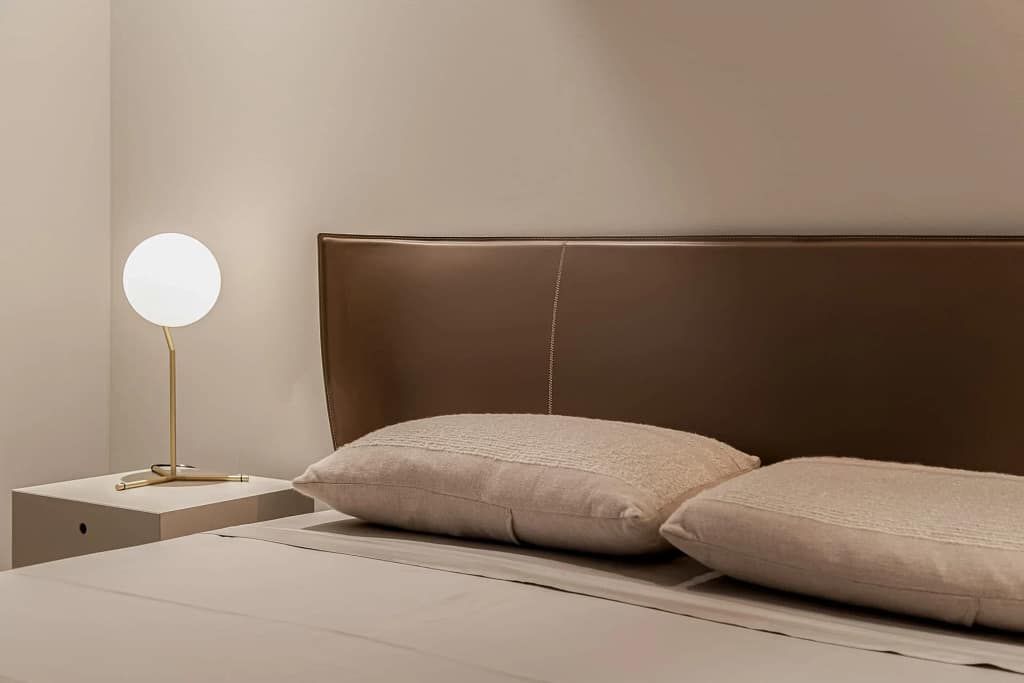
In bedrooms the light must be low, warm and indirect: adjustable bedside lamps for reading, general light reflected off the ceiling, night step lights towards the bathroom. No source visible from the bed. Blackout curtains, controlled by the home automation, complete the design.
Bathrooms
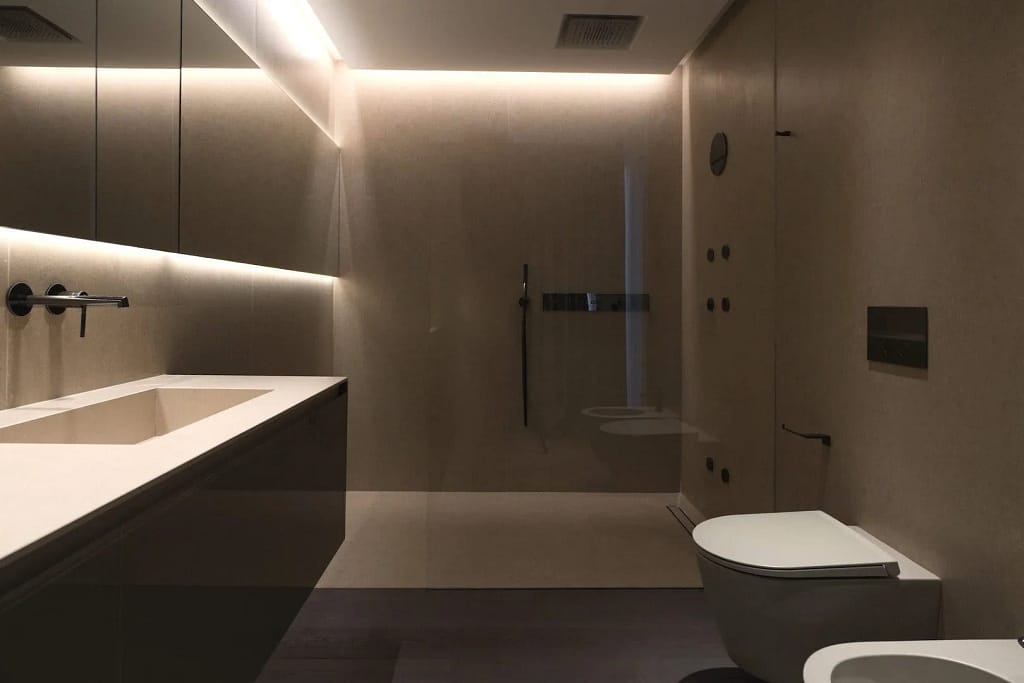
At the mirror you need even front lighting that casts no shadows on the face; in the shower a water-protected light; elsewhere soft, dimmable light. In the master bathroom designer lighting can turn the bathtub into a place of evening relaxation, as we describe on the page about the luxury bathroom.
Integrating light into the architecture
In minimalist villas the best light is often the one you cannot see: slots in the plasterboard, coves in the ceilings, profiles embedded in the walls, light coming from under a floating cabinet. These details are drawn together with the walls, with the exact dimensions of the recesses and the position of the drivers.
Designer lighting coordinates the work of architect, electrician, plasterboard installer and joiner. An error of a few millimetres is visible forever; this is why lighting details go into the construction drawings like every other building element.
The Villa Edit

The Villa Edit

Explore our projects

Edra sofas, Varenna kitchen, Noorth and Agape bathrooms: a project by the studio.
Efficiency and durability
LED sources use little energy and last a long time, but they are not all the same: colour rendering, colour stability over time, dimming quality and driver noise all vary. For the designer lighting of a villa we choose fittings with complete technical data and available spare parts, so that a whole line does not have to be replaced when a component fails.
Designer lighting and works of art
Paintings, sculptures and collectible objects call for dedicated light: spotlights with narrow, adjustable optics, sources with very high colour rendering, no ultraviolet that could damage the most delicate works. The light must reveal the work without reflections on the glass and without dazzling the viewer. We cover this on the page about art and design objects.
When a collection changes over time, electrified tracks or magnetic systems allow spotlights to be moved without building work. It is a choice that designer lighting must plan from the outset, together with the walls intended to host the works.
The Villa Edit

The Villa Edit

How much does a lighting design cost
The cost depends on the size of the villa, the number of scenes, the type of fittings and the control system. More than the price of individual lamps, the building work weighs: chases, ceilings, recesses, drivers. This is why the designer lighting budget is defined in the design, item by item, not with a price per square metre.
Designer lighting in the studio's projects
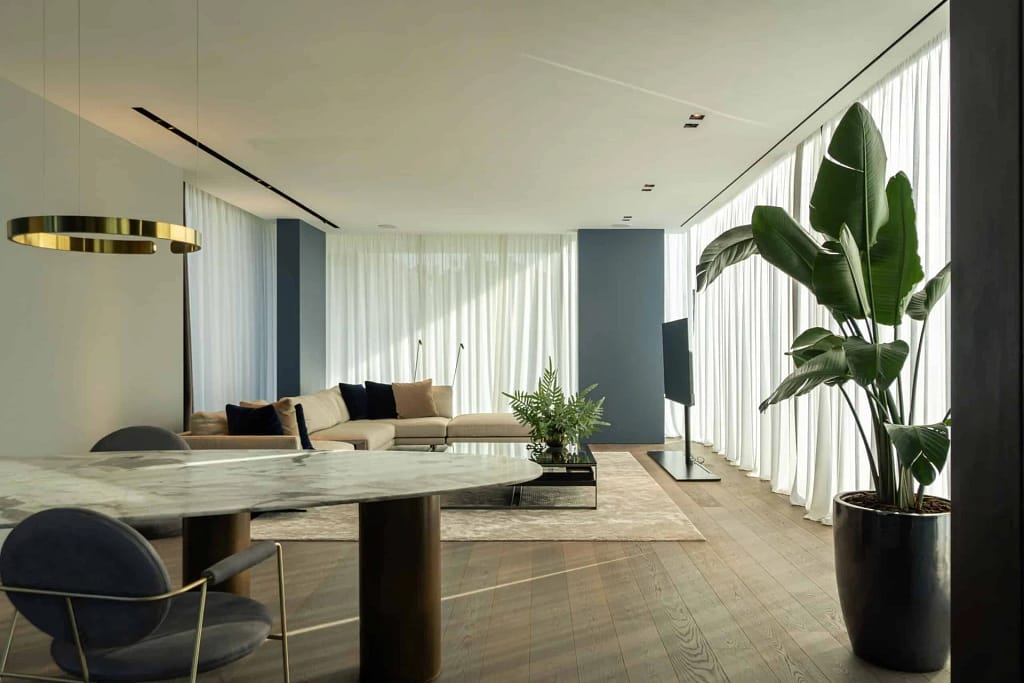
In the AV Home villa, which you see in the images on this page, light shapes the volumes even at night: slots of light in the ceilings, backlit niches in dark wood, a ring pendant above the table, the pool lit like a lantern. It is the designer lighting we look for in every project: few sources, plenty of atmosphere, no glare.
The same approach applies outdoors: the facade is lit with warm grazing light, the garden with a few low points, the entrance path with discreet step lights. The result is a house that is recognisable even at night, without light pollution.
Designer lighting and savings
A good designer lighting project uses little energy: efficient LED sources, light where and when it is needed, presence sensors in service rooms, automatic switch-off when the house is empty. The savings come not from reducing light, but from designing it well.
One last piece of advice on designer lighting: before choosing, look at the house at night during construction, with temporary lamps. Understanding where light is needed and where shadow is needed is the best way to avoid costly mistakes and to arrive at a villa that is as beautiful in the evening as it is by day.
The Villa Edit

The Villa Edit

The Villa Edit

The most common mistakes
Choosing lamps at the end of construction, when the chases are closed. Placing spotlights in a regular grid everywhere, lighting the floor instead of the walls. Using cold light in living areas. Forgetting dimming. Over-lighting the garden. Not providing access to drivers and power supplies for maintenance.
The Villa Edit

Longevity
Longevity and biohacking lifestyle: scientific protocols, curated products and dedicated retreats…
Maintenance
LED sources last many years, but drivers and power supplies can fail: they must be installed in reachable positions and documented in the villa’s file. Decorative lamps are cleaned carefully following the manufacturer’s instructions; outdoor fittings should be checked every year for seals and corrosion.
How it fits with the rest of the house
Designer lighting enhances natural stone and porcelain tiles, accompanies the furniture, is controlled by the home automation and transforms the garden and pool at night. It is designed together with the architecture, not afterwards.
Frequently asked questions about designer lighting
When should the lighting be designed?
Together with the architectural design, before the electrical installation: chases, ceilings and recesses depend on the lighting design.
Spotlights or indirect light?
Both, each for its role: indirect light for the general atmosphere, adjustable spotlights for accents and tasks.
Which colour temperature for a villa?
Warm light in living and sleeping areas, more neutral only where you work. Dimming counts as much as temperature.
Do you need a lighting designer?
For a villa, yes: the architect and the lighting designer work together on the same drawings.
How do you choose a decorative lamp?
From the proportions of the space and the light it must give: a pendant above the table must light the surface without glare, a floor lamp must accompany reading. Design comes after function.
Designing the light with the studio
The studio of Federico Cappellina designs light as a material of architecture: from natural light to the choice of lamps, all the way to the home automation scenes.
Architecture
UHNW luxury villa architecture by Federico Cappellina: pure volumes, curated materials…
Planning a villa?
The studio coordinates architecture, materials, building services and furniture in a single project.
Discover the whole UHNW lifestyle
Lighting is the sixth of the twelve systems of The Villa Edit.