
ELRE
Home automation, security and robotics
A villa should not have thirty apps: it should have one system. How we design home automation so that technology disappears and everything simply works.
Home automation: technology that disappears
Home automation is the system that makes the house’s installations talk to each other: lighting, blinds, climate, ventilation, energy, irrigation, pool, audio, security and access. In a contemporary villa it is not a gadget: it is the way to manage dozens of systems with a few gestures, even remotely, and to let the house run itself when nobody is home.
True luxury is not a house full of technology, but a house in which technology disappears. Good home automation does not require reading a manual: one button at the entrance switches everything off and arms the alarm, a scene in the bedroom lowers blinds and lights, the house warms up before you return.
One system, not thirty apps
The first principle of home automation is integration. Every manufacturer offers its own app: heat pump, pool, blinds, alarm, irrigation. Without a common system the villa becomes a collection of remote controls. A single home automation system coordinates everything and offers one interface, on the wall controls and on the phone.
The second principle is reliability: essential functions must work even without the internet. We prefer systems with local processing, which keep managing lighting, climate and security if the connection drops.
Explore The Villa Edit
The Villa Edit
The method and the 12 systems
Structure and passive house
Building system and Passivhaus
Windows and glazing
Windows, sliding doors, doors
Energy, air and water
Heat pump, ventilation, solar
Natural stone
Marble, travertine, wood
Porcelain tiles
Large slabs inside and out
Lighting
Designing the light
Luxury kitchens
Kitchen, appliances, compost
Bathroom, spa and wellness
Master bathroom, sauna, recovery
Furniture
Living, bedrooms, walk-in closets
Pools and gardens
Outdoor, landscape, robots
Home automation and security
One system for the whole house
Art and objects
Collections and signature pieces
Private service
Private consultation
Would you like to design the home automation of your villa?
Contact usStandards and systems
KNX, the open standard
KNX is an open standard for building automation, used by hundreds of manufacturers. Its advantage is independence: components from different brands speak the same language and the house does not depend on a single supplier. It is the base we often use in villas.
Loxone
Loxone, an Austrian company, offers a complete system with local processing that integrates lighting, climate, shading, energy, security, audio, pool and irrigation. It works with a network of certified installer partners.
Crestron and Lutron
Crestron is a reference for high-end audio, video and room control; Lutron specialises in lighting and blind control. They integrate with automation systems for very complex villas.
Wall controls
The wall control is the only part of home automation you touch every day: it must be beautiful and intuitive. Brands such as Basalte, Gira and Vimar offer plates and keypads in fine materials, coordinated with the finishes of the house.
What home automation can do in a villa
Lighting: scenes, dimming, automatic switch-on at sunset, presence simulation. Blinds and shading: closing when the sun heats too much, opening in light wind, protection in a storm. Climate: room-by-room temperature, scheduling, management of the mechanical ventilation according to air quality.
Energy: using solar energy when available, load management, car charging. Water: irrigation with sensors, leak sensors that shut off the water, pool control. Audio and video: music in every room, home cinema, video intercom on the phone.


Security on three levels
Perimeter
The first level protects the plot: automated gates, discreet cameras with image analysis, sensors on the paths, lights that switch on as you pass, video intercom. The goal is to know who is approaching before they reach the house.
Building
The second level protects the house: contacts on doors and windows, motion sensors, burglar-resistant glass, security doors. It also includes technical sensors: smoke, flooding, gas where present. We also cover this on the page about windows.
People
The third level protects the people who live there: personalised access for family, guests and staff, an entry log, panic buttons, possibly a safe room. Security works with home automation: if a fire alarm goes off, the lights come on, escape routes open, the ventilation stops and notifications are sent.

The Villa Edit

Explore our projects

Metra glazing, Viabizzuno and OTY lighting, infinity pool: designed and supervised by the studio.
Privacy and cybersecurity
A connected villa is also a cyber target. The home network must be designed like an installation: separate networks for guests, home devices and cameras, strong passwords, regular updates, protected remote access. Camera footage must remain under the owner’s control. We never publish details of the security systems of the villas we design.
Domestic robotics
Robotics has already entered villas: robot vacuums and floor washers, robotic mowers, pool-cleaning robots. The design must provide charging stations, obstacle-free routes and flush thresholds that robots can cross easily. We also cover this on the page about pools and gardens.
In the coming years more capable robots will arrive, for maintenance and assistance. A villa designed today must be ready: service spaces, a reliable network, accessible installations. It is better to plan ahead than to chase.

Artificial intelligence in the home
Tomorrow’s home automation will increasingly use artificial intelligence to learn habits, forecast consumption and flag a fault before it happens: a ventilation filter to change, a pump using more than usual. These functions are useful if they remain under the owner’s control and the data stay private.
The studio's standard
A single home automation system with local processing; open standards where possible; simple wall controls coordinated with the finishes; a designed, segmented home network; security on perimeter, building and people; accessible panels and control units; complete programming documentation handed over to the owner.
Three levels: Essential, Signature, Icon
Essential: KNX home automation for lighting, blinds and climate, integrated alarm. Signature: complete home automation with energy, ventilation, irrigation, pool, video surveillance and personalised access. Icon: audio and video integration, advanced security with a safe room, predictive monitoring and remote support.
Independent selection: the brands mentioned are chosen for quality, performance and service. No brand pays to appear on this page and the links lead to the official websites. Prices, availability and terms should be checked with the manufacturer or with the studio during the design phase.
The Villa Edit

The Villa Edit

Home automation room by room
Entrance
At the entrance a single button closes the house: it switches off the lights, lowers the blinds where needed, sets the climate to away mode and arms the alarm. When you return the door opens with your phone, a code or a fingerprint, and the house gets ready: courtesy lights on, alarm disarmed, temperature already right.
Living room
In the living room home automation manages lighting scenes, blinds, music and video: one scene for dinner, one for cinema, one for reading. Controls stay simple: a few clear buttons on the wall and the option of using the phone or voice for those who want it.
Bedrooms
In the bedroom home automation lowers blinds and lights at bedtime, adjusts temperature and ventilation for the night and switches on low lights if you get up. In the morning the blinds open gradually. Sleep is explored in our wellbeing section.
Outdoors
Outdoors home automation manages irrigation, garden lights, pool, gates and cameras. Bioclimatic pergolas close when it rains; awnings retract in strong wind. Everything is controlled from a single interface.
Explore our projects

Schüco glazing, Minimal Cucine and Modulnova kitchen, Poliform and Baxter furniture, Occhio lighting, MAFI wood.
Home automation and energy
One of the most useful functions of home automation is energy management. The system knows how much energy the panels produce and how much the house uses: it starts the dishwasher, charges the car or filters the pool when the sun is out, avoids exceeding the available power and shows consumption room by room. We cover this on the page about energy, air and water.
The house when you are away
Many villas stay empty for weeks. Home automation keeps them under control: a minimum temperature to avoid damage, ventilation for humidity, presence simulation with lights and blinds, flood sensors that shut off the water, immediate notifications in case of an alarm. A support service can intervene remotely or send a technician.
Home automation and accessibility
Good home automation makes the house easier to live in at any age: voice commands, motorised doors and blinds, automatic night lights, alerts in case of falls or doors left open. These functions give comfort today and tomorrow let you stay in your own home for a long time.
The Villa Edit

Who designs and who installs
The home automation of a villa is designed by three people: the architect, who defines functions, scenes and controls; the electrical engineer, who sizes panels and lines; the system integrator, who programs the system. This is why we choose installers certified by the system manufacturer and ask for all documentation and programming to be handed over to the owner.
Home automation and audio-video
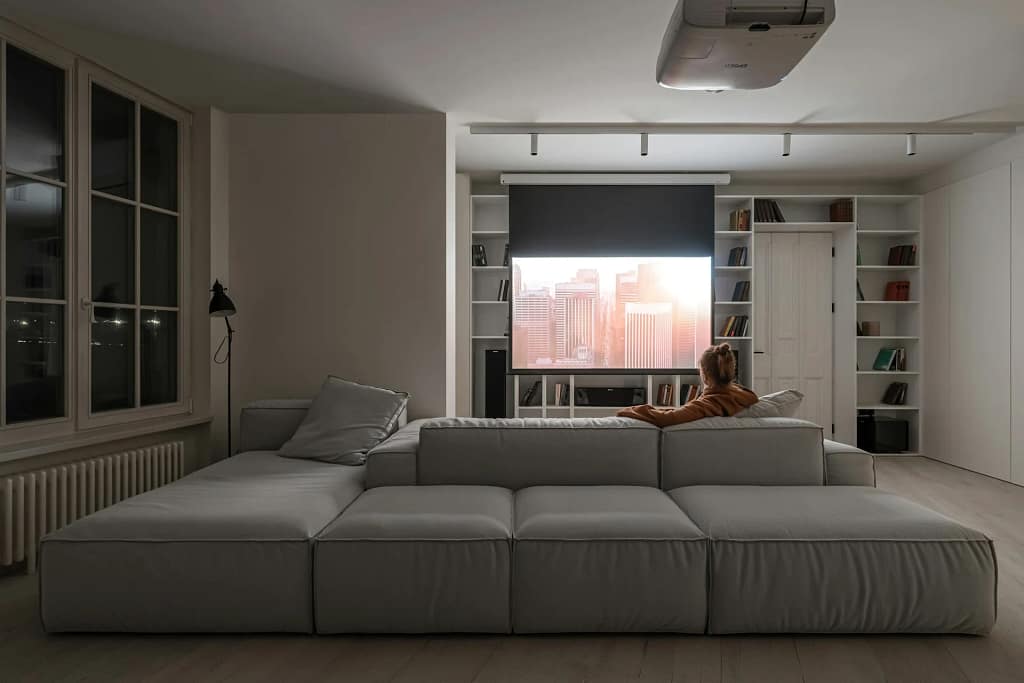
Music in every room, with invisible speakers recessed into the ceiling, and a home cinema with projector, motorised screen and treated acoustics are among the most appreciated functions. Home automation coordinates lights, blinds and audio with a single gesture: the film starts, the lights dim, the blinds close. The cabling is planned in the design, because adding it later is difficult.
How much does home automation cost
The cost of home automation depends on the number of functions, rooms and devices, the chosen system and the programming. The installations that home automation controls, such as motorised blinds, audio and security, weigh more than the control unit itself. The budget is built in the design, function by function, choosing what is really worth automating and what to keep simple.
A useful rule: automate what is repeated every day or protects the house, keep manual what is rarely used. Restrained home automation is more reliable and easier to live with than one full of functions nobody uses.
The Villa Edit

Explore our projects

Edra sofas, Varenna kitchen, Noorth and Agape bathrooms: a project by the studio.
Home automation in everyday life
The success of home automation is measured after a few months: if the family uses it without thinking, the project has succeeded. This is why, at handover, we explain the system to the people who live in the house, leave simple instructions and collect change requests in the first months, when real habits emerge. The programming adapts to people, not the other way round.
Home automation and ventilation
Home automation regulates the mechanical ventilation according to carbon dioxide and humidity sensors, increases the air change after a shower or a dinner with many guests and reduces it when the house is empty. The air stays good and consumption low, without anyone having to think about it.
Home automation and the pool
The pool is one of the installations that benefits most from home automation: filtration scheduled during sunny hours, heating with solar energy, a remotely operated cover, underwater lights in the evening scenes, an alert if the water readings go out of range. We cover this on the page about pools and gardens.
The Villa Edit

The Villa Edit

Home automation and predictive maintenance
Home automation connected to the sensors of the installations can flag a problem in advance: a clogged filter, a pump using more than usual, a water leak. This is valuable information for whoever manages the house and for the support service, which can intervene before the fault.
The criterion with which we design home automation is simple: every function must solve a real problem or protect the house. The rest is noise. A well-designed villa works well even with few controls, and technology stays at the service of the people who live there, not the other way round.
The most common mistakes
Adding devices one at a time, each with its own app. Depending only on the cloud for essential functions. Putting too many buttons on the plates. Not documenting the programming, making any future change impossible. Forgetting cybersecurity. Hiding control units where no technician can reach them.
The Villa Edit

The Villa Edit

Maintenance and updates
Home automation requires periodic updates, checks of wireless sensor batteries, and testing of security systems and cameras. A service contract with the installer guarantees quick interventions. In the villa’s file we collect diagrams, programming, technical credentials handed over securely, and contacts.

The Villa Edit

The Villa Edit

How it fits with the rest of the house
Home automation is the thread that ties all the systems together: energy and ventilation, lighting, windows and blinds, pool and garden, kitchen and wellness. It is designed at the start, together with the electrical installation, because it runs everywhere.
Frequently asked questions about home automation
Does home automation work without the internet?
With a locally processed system, yes: lighting, climate and security keep working; without the internet you only lose remote control.
Can home automation be added to an existing house?
Yes, with wireless systems or using existing conduits, but the best result comes from designing it with the house.
KNX or a proprietary system?
KNX guarantees independence from manufacturers; proprietary systems are often simpler to program. The choice depends on the villa and the installer.
Does home automation make the house safer?
Yes, if it integrates alarm, video surveillance and technical sensors and if the home network is protected.
Can home automation be expanded over time?
Yes, if the design provides panels with spare space, reserve cabling and an open system: functions, rooms and devices can be added without redoing the installation.
Designing home automation with the studio
The studio of Federico Cappellina designs home automation together with the architecture and the installations: scenes, controls, security and integration with every system of the villa.
Planning a villa?
The studio coordinates architecture, materials, building services and furniture in a single project.
Discover the whole UHNW lifestyle
Home automation and security are the eleventh of the twelve systems of The Villa Edit, the link between all the others.